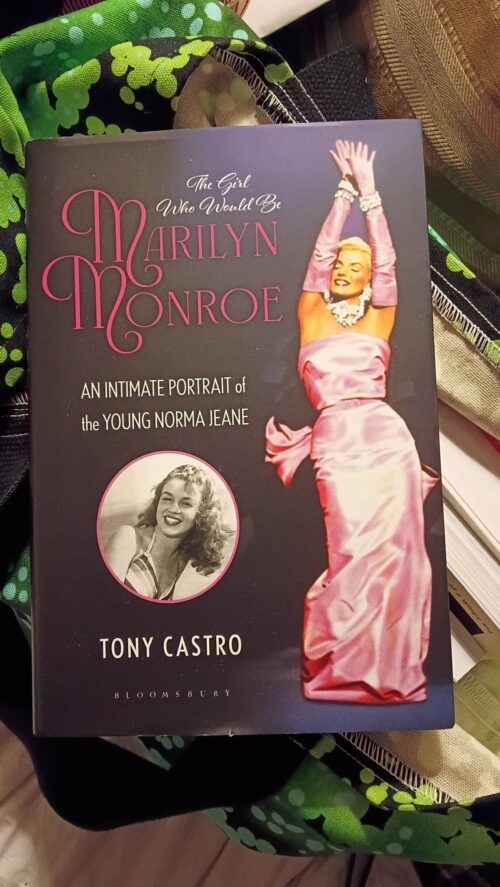
 When you read The Girl Who Would Be Marilyn Monroe: An Intimate Portrait of the Young Norma Jeane by Tony Castro, you can tell me which is more purple: the myth of Marilyn Monroe or the writing of this biography.
I have gotten only about two or three chapters into it, viewed the black and white photographs in the middle of the book and I do not think I will go much farther. I was already confused multiple times by the fourth or fifth page as there was information that didn’t seem to be important (or at least could be if the point was made more quickly) and then there were too many names. And I don’t just mean there was Gladys and Marylin and Ida and Grace and so forth (the women that came in and out of things) but this person was Monroe, but then married Brown, but then fooled around with Smith and then she married Baker but “her” (which her? Your guess might be better than mine) father was from Mexico (but wasn’t he from Indiana?), and that was just one person, never mind the other women of Norma Jeane’s life, and then there was the point about a name being actually spelled Brown, but mistakenly written Browne*…. WOAH! Hold your Adams and your Hoss’s and your Joes!
And don’t get me started on the fact that first Norma Jeane is living with her mom, but then with her foster family, then back with mom, and flash forward to her talking about being the Baby Nobody Wanted and then back to age three with her foster family, but then about being a baby in a crib, (but wasn’t she living with her mom then?) And don’t get me started about how she could smell the canvas duffle bag her mother tried to kidnap her in. (How does Castro know that? Was he there? How is this a fact?) There were a lot of jumping timelines and not keeping to a straight line from A to B.
Needless to say a lot of fictionalized thoughts seemingly goes into what Castro thinks, hopes or wants to happen instead of sticking to hard facts only. It was published for the 100th anniversary of her birth and I think a hardcore fan would love to add this to their collection. It is a letter of love to the woman, and maybe not just to Marilyn but to Norma Jeane as well. For me, if Castro had focused more on building the character of Monroe through her family history (it seems like her family had serious mental health issues, and a fact about a male family member made me wonder if that was the reason for this situation) I probably would have been more interested in finishing. If I gave it a little more time, maybe I could have gotten into it, but as it was, it was not for me at this time in my reading journey.
(*Names changed to make it easier for me to get the point across)
