I might recover from the sadness that Grandpa’s Cats gave me by March 2027, but I’m not sure. It might be a funny and sweet, but it’s also a difficult story of loss. But there is loss. Especially at the end. The end has a bad scene that shows why Grandpa isn’t taking care of the cats, and Grandma is (somewhat) taking care of them.

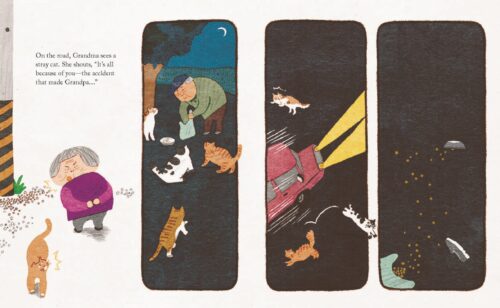
Chih-Hao Yen, do you enjoy making me cry? And laugh and cry again and grumble? Hui-Yin Hsueh did you have to have some silly, goofy, thoughtful, simple but not simplistic images? Did you both have to make Grandpa’s Cats? Couldn’t you have just left my heartstrings alone? And you, yes you, translator Michelle Kuo. You could have said no, you know! No thank you, I don’t want to translate a book about a woman who hates cats because it was a cat, a cat that Grandpa loved, that caused Grandpa to not be with grandma!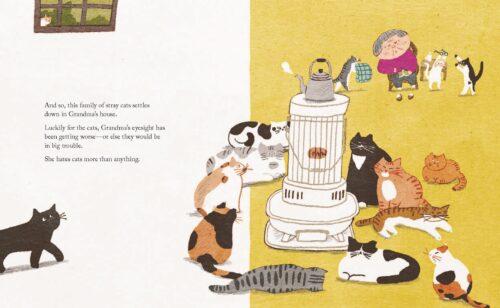
This is a great book about loss, but in many ways aimed at the adult and not the child. I think it is a “know your reader” kind of book and pick the right audience. At first I didn’t like the images, they were too simple and a bit stereotypical. Then I got into them. The idea of how Grandma comes to well, live with the cats is humorous, clever and also a little sad. This book deals with the death of Grandpa and Grandma’s dementia. It deals with love, loss and family. It is obvious fairly early on that this is not a typical American story, but has an element of what I can only say is Taiwanese (it felt like other books I’ve read by Chinese authors, but I’ve not read a lot of Taiwanese authors, so I went to what I was familiar with).
Now, I can’t recommend this book. I can’t recommend it enough. (I have mixed feelings about it, if you haven’t guessed?)