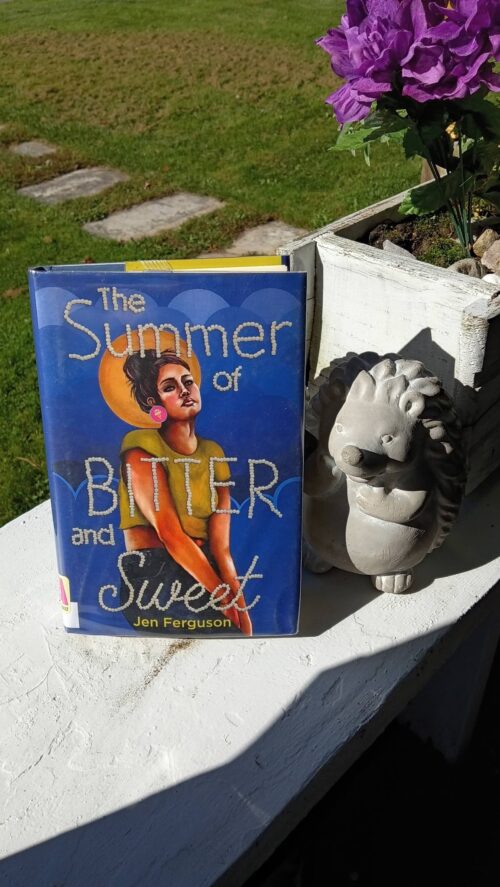
 In September, I was going to read two books for a reading challenge, but it took so long to obtain them, the month was almost over and I didn’t have time to really start reading. But since I had them, I figured I might as well read. Between the two, they have themes I don’t usually read (romance and/or contemporary novels) so why not step outside my usual read? I picked up one, then the second one, The Summer of Bitter and Sweet by Jen Ferguson. Well, neither was great but with Summer I didn’t want to toss it across the room (see Today Tonight Tomorrow by Rachel Lynn Solomon’s review).
It is a coming of age with cultural and LGBTQ elements. I found it slow and repetitive in a few places, (unless you tell me you have a leather bag with the bad fringe, I don’t care that you have a leather bag with the good fringe. Every. Single. Time. You. Pick. It. Up.). Bringing in the themes of being asexual and demisexual was a nice addition to representation. It is a little forced, but it’s nice to see representation. Is it very specific? Yes, but there are people who are Ace/Demi and people who don’t know about that so it was good. But a smidgen more explanation would have been nice. I mean, I know, but if you’re a teen, you’re probably not in the know. Our main character is a Métis-White teen (Louisa “Lou” Norquay) and she is trying to deal with the end of her childhood and the start of being an adult. She’s 18, smart, just graduated from her senior year of school, is pretty, getting ready for college that she can’t afford, learning about the past (hers, her mothers, her people), cultural situations and coming to terms with an act she and her (then) best friend did. There were some issues with the idea that only the Metis people understand generational trauma, racism, sexism, stereotypes for me (um…your future boyfriend is black, your BFF is queer and has mental health issues, your uncle’s ex-boyfriend is a gay police officer in a very conservative town), but it works, too.
Lou is a child of rape. Her mother was 16 and would leave home soon as she could, taking her daughter with her. Always moving, no place to call home, always being “those people” (mom couldn’t be a good mom as she’s native, single, young) with fear of social services for Lou. When they come back to her mothers home town (where Lou was born) to live with Lou’s two uncles on the family farm, things take a turn. Lou tells lies for protection. Loses her best friend, goes “angry native auntie” and when she burns out, then tries to understand lies versus secrets, what does it mean to claim a name, claim your ethnicity, and own what you have done.
Graphic elements are racism, violence, sexual harassment, and racial slurs. More moderate to graphic elements are rape, sexual assault, injury details, mental health and stalking. With minor elements of abortion, alcohol, addiction and foster care mixed in. The author has said they liked other characters more than their main narrative one. I agree. I never wanted to be friends with Louisa. I wanted to know what King (hottie boyfriend potential) looks like. I really wanted to kick Wyatt (an exboyfriend) in the…butt. And for the guy who attacks Louisa and her friends? I want to find a deep hole in the middle of nowhere.
Ferguson wrote this book for Teen Them. Sure, I had faults with the overallness of things, but I like the representation of native Canadian culture, the political elements of that, the LGBTQ elements and dynamics of Lou and her “sperm donor” (who really captures a lot of the story in is slimy way) and it really understands what it is like to be a woman in today’s society. Therefore, is this book perfect? No, but then again, who of us is?
