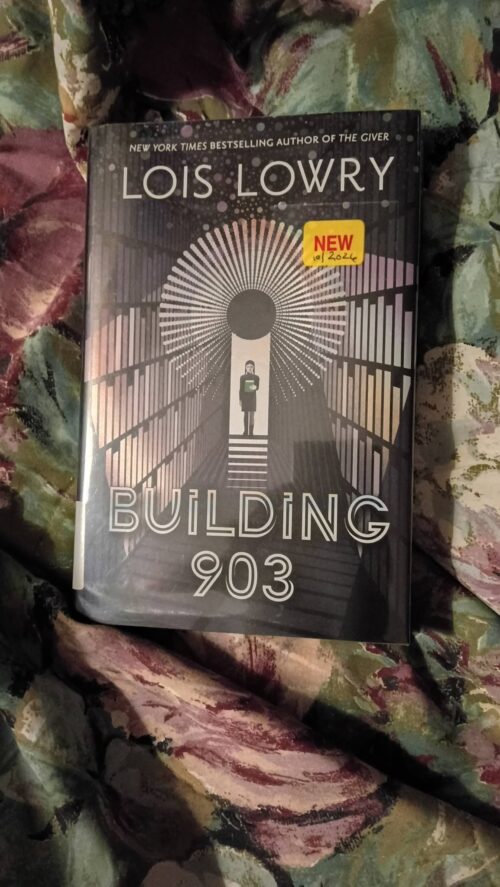
 Recently (as in the morning I wrote this review) I learned of the term “cursorily acclaimed.” And I think sometimes the reviews and praise of Lois Lowry fall into this realm. Now, I’m not sure if I’m using it correctly, but I think that the idea of it fits what I thought about Building 903 by Lowry. Sometimes I think readers, critics, reviewers, etc, don’t really “get into things” when it comes to her work. I honestly think sometimes she is given brief, hasty, or superficial praise (Google definition) because she is a good writer and has written good things. I think sometimes people think, “It’s Lowry, so of course it is good.” without really analyzing it. And the praise I have heard surrounding Building 903 falls into that category.
A friend of mine had read the book and said she did not like it as much as she’d hoped. In fact, the ending was unsatisfactory. And while I had wanted to read it before, now I was curious. What was “wrong” with the book for her to feel this way? I told her that it wasn’t that I didn’t believe her, when I told her I was reading it, it was that she just made me curious about what was the cause of her feelings.
There was a moment or two when I stared where I was falling asleep. I realized it wasn’t the book, despite its slow pacing, but my mental state. As an adult, I think you need to be in a quiet, comfortable place to read it. Aimed at ages of 8 to 10 will be fine. However, while I thought it was slow, and I felt there were several holes in the action, background and a few places individually, overall this is a decent, interesting read. The theme of banning practically anything that would make a person an imaginative individual comes to an interesting head. The dictator leader of the people brings up a lot of commentary. As do the themes of the book which include such things as reverse book banning, the idea of crimes and what they really are and how they should be punished.There is the theme of religion, faith and age (how we treat the young, the “right ages” for life alternating events, how we treat the older population). Commentary about the power of the written word plays a major role. And it does not end there, but so much is included. Yet, there were those holes that made me wonder what else could be included.
The book is set in the not too far off future, where the population can live well into their 100’s with 150 being the new 70. “Our time” is being used in the way we use World War Two for time references. Characters are not always fleshed out, some terms are overused, others underused, and the ending has an important part we never get to see. Opportunities are missed and should have been seen by the reader. Such as the population finally rising up against the government and status quo (I guess the idea that the revolution is not televised (though everything else can be) is true).
I must admit this book was not perfect for me, but I think it earned its rating of Three.
