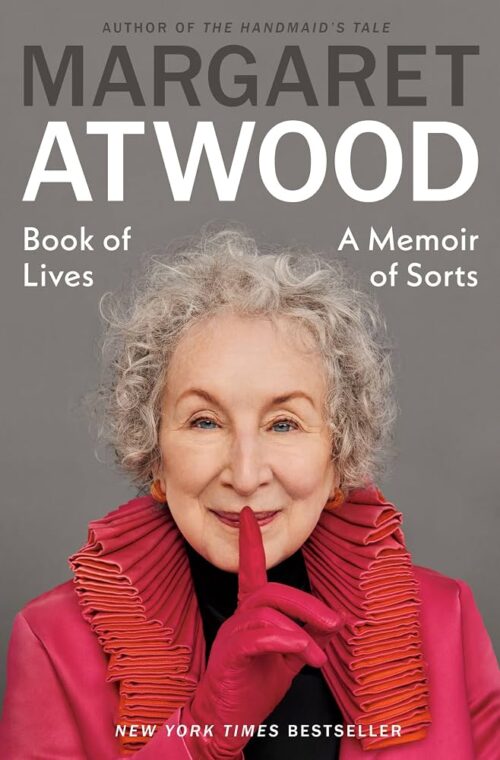
 I’ve only read three books by Margaret Atwood, including The Blind Assassin, The Handmaid’s Tale, and The Testaments. I was impressed by all of them, but The Handmaid’s Tale made a lasting impression on me. I cannot overemphasize how much that book affected me, and how it comes to mind whenever another unfortunate current event strays a little too close to the plot. Because of my admiration for Atwood’s writing, I took an online “Masterclass” with her. Although I don’t remember too many specifics of the class, I recall finding Atwood clever and funny. So. when I saw that Atwood had a memoir out, I knew I wanted to read it.
I came into Book of Lives (2025) knowing almost nothing about Margaret Atwood. However, after over six hundred detailed pages, I learned a lot about her childhood, her personal life, and her professional life. A lot of the information was new to me and very interesting. Atwood is Canadian. Her father was an entomologist, and she spent much of her childhood in the woods of northern Quebec–living in various cabins and shelters built by her father. Back before the age of helicopter parents, Atwood had a lot of time and freedom to run around in the woods with her older brother.
When Atwood was old enough to go to school, they would spend the school years in town and then head out to the woods again in the summer. She described how one, particular “mean” girl during her elementary years was the inspiration for her book Cat’s Eye, and how much she learned from that relationship.
Besides Atwood’s unconventional childhood, I was also not aware of how much education Atwood had obtained. Besides a bachelor’s and master’s degree in literature, she also pursued a Ph.D at Harvard. In addition, Atwood was always creative, and she dedicated herself to writing when she was still pretty young. It’s easy to imagine that Atwood’s success was destined, but it took a lot of guts to stick out such an unlikely dream. It was Atwood’s consistent hard work that eventually paid off.
On a more personal note, Margaret’s romantic partner, Graeme Gibson played a huge role in her life. She met him when they were both married to other people, but they eventually got together despite the potential messiness of Graeme’s ex-wife and three kids. They were together for over forty years, having one child together, and never marrying. Atwood mentions that she would have liked to be married and have another child, but Graeme did not. Sometimes the fact that she was not married was held up as a feminist ideal, but she did not intend it as such. When Graeme eventually got dementia, his decline was heartbreaking to read about.
I am glad I read this book. I learned a lot about Atwood’s life, and I was impressed by how much she could recall of the past. There were many witty, little lines thrown in here and there that really made the book feel like her. On the other hand, there was also a lot of detail that could be tiresome and hard to follow. Atwood delves so deeply into who she worked with and various companies and editors, that I had a hard time keeping them straight. I was always more interested in the personal stories and Atwood’s often quick, pointed observations of the many sexist things she’s seen in her life.
You can find all my reviews on my blog.
