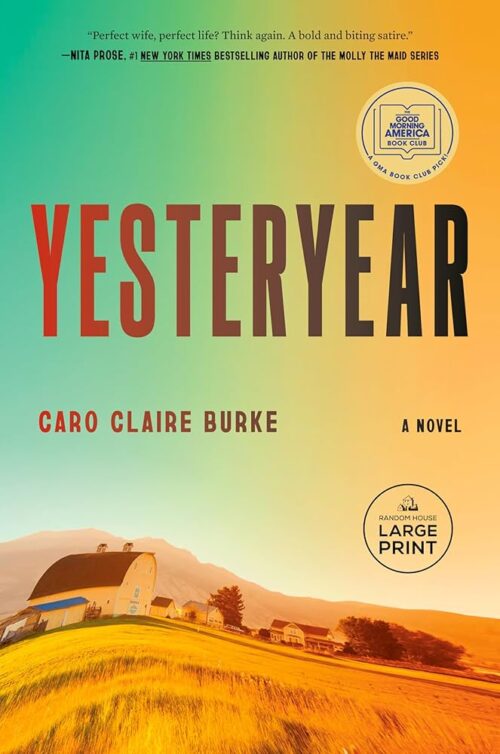
 I can’t remember where I first heard of Yesteryear (2026) by Caro Claire Burk, but I was immediately intrigued by the premise. A successful Youtuber “trad wife” suddenly finds herself back in the year 1855 as an OG “trad” wife. I knew nothing else about the novel, but I was hoping for some clever satire.
The book begins with our protagonist, Natalie Heller Mills doing an interview. She lives in a gorgeous farmstead with her husband and five (?) children–with one on the way. Their lives are picture perfect and enviable–at least the lives that are projected out on social media. Natalie makes bread from scratch and homeschools her children while her husband takes care of the farm. They live a beautiful, romantic life.
But like almost everything on social media, appearances can be deceiving. Natalie has two nannies who do most of the childcare and all of the schooling. They started with money from her husband’s father, and they have an army of immigrant labor to help with the farm. In addition, Natalie and her husband are really a couple in name only. They act for the cameras, but there is nothing to envy there.
One morning, Natalie wakes up and its freezing cold. She’s in her house, but it doesn’t feel like her house anymore. There is no electricity, refrigerator, or heat. All of her creature comforts are gone. Her children look like her children, but not quite. And her husband seems like her husband, but he looks like an old, bearded man.
The book alternates chapters between Natalie back in 1855, and how Natalie grew up and came to be the wildly popular social media influencer that she was. I found the chapters about Natalie’s past more interesting to read. I felt myself feeling sorry for her as well as being shocked at some of her actions towards her roommate, employees, and family. But all of these chapters really clarified Natalie as a character.
I was expecting a quick satire about some of these women I’ve seen on Instagram who loudly deride feminism while ignorantly using the power feminists of earlier generations fought for. However, this book was much more complex than I was expecting. The characters and relationships were intricate and there was more going on than a simple satire. Instead, the overwhelming feeling I got from this book was that no matter what direction you try to go, being a woman can suck. Natalie tried to do what she had been taught was right, and she found herself trapped and miserable. Natalie’s sister was trapped and miserable in a different way. Even Natalie’s progressive roommate was trapped in a miserable job that took over her life and men that treated her badly.
I’m not sure how I feel about the ending of this book, but overall I’m impressed with it. It was original, intricate, timely, and thoughtful.
You can find all my reviews on my blog.
