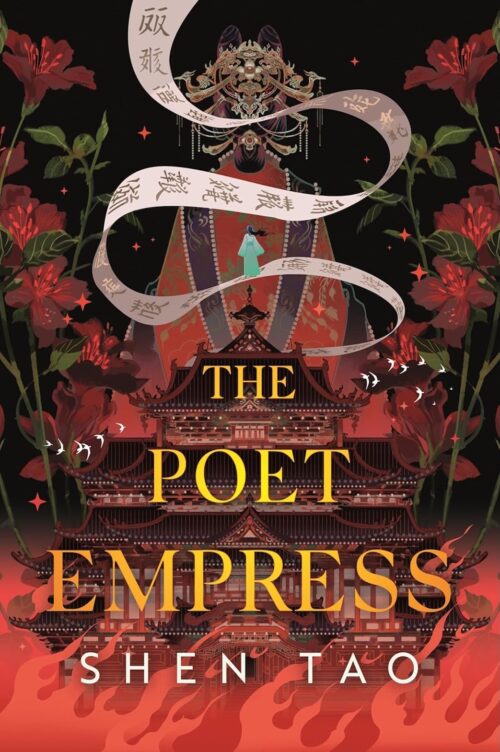
 I have both ElCicco and Narfa for bringing this book to my attention earlier this year. Completely worth it and up there with The Everlasting and The Raven Scholar as one of the best page turner’s of the year so far.
Very mild spoilers below:
This is another one of those fantasy novels that carries over a close Venn diagram with another sub genre—in this case politics intrigue. If you like stories about court politics, this will likely appeal. In the kingdom of Tensha, inheritance through the male line is not always straight forward. thanks to the power of magic. Each of the emperor’s sons—and he may have many—have their own personal blessings that can become greatly amplified if they are ever become crowned emperor themselves. After many years of currying his fathers’s favor, eldest son Prince Maro has been suddenly superseded by his younger brother Prince Terren. Maro can dig tunnels and Terren can generate weapons; when you are country constantly mired in wars, a young boy whose power is basically swords might sound ideal.
But Terren is both violent and cruel. He is also nigh-on unkillable by conventional means. But there is someone is willing to try. Wei, a poor rice farmer’s daughter who will put everything on theline to make sure her little brother doesn’t stave, offers herself as a concubine to the young prince—and is shockingly chosen. She then very quickly becomes Prince Terren’s favorite punching bag. She, like most of the populace, does not have access to the same powerful blessings of the royal family, but there is a level of magic that is within reach of common people that works through writing. Pity women like Wei are not permitted to become literate.
You can see where this is going
So this gives Wei two tasks: she first has to learn to read and write on the sly. Then, she has to learn enough about Prince Terren in order to write a “heart poem” potent enough to strike him down. It turns out you need to love someone in order to know them well enough to kill them. But there’s no way Wei can bring herself to love a man who tortures her at night. (I am not kidding here—he’s pretty vile.) Instead, Wei decides that her best course of action is to find those people who loved Terren as a boy, and take advantage of what they remember from him when he was more beloved. From all accounts, Terran was a rather sweet boy—what happened? How does a young child become the cruel man that we meet on the page? And is there even a remote chance that love could redeem the man he has become?
Wei’s marrige to Terran puts a lot of noses out of joint, and multiple members of the court try and displace—or even better, kill—this upstart little nobody of a farmer’s daughter. This makes Wei’s sneaking off to learn about her new husband’s history even more difficult. In my opinion, this was the greatest strength of The Poet Empress: the court intrigue. The politicking! Wei goes from a naive (but no means overly idealistic) young girl to someone who learns how to play the game. She also becomes a much more astute judge of character. She still tries to remain as empathetic as possible, without putting herself at risk, of course. But even nice, well-meaning girls will learn to bargain for power, if they have to.
The secondary characters at court are also well thought out, but only slowly. They may initially seem only very roughly sketched, but they eventually become more and more filled out; nearly ever one of them is more multifaceted than you are originally lead to believe. I think the rapid-fire chapters helped facilitate this, and I believe the author’s intent here was to have the reader’s impressions of court memebers mirror and develop alongside Wei’s own. I have to say, it works. They all have their own private motivations and their own blindspots that will not be immediatly noticable to either Wei or the reader. This makes it difficult to predict how they’ll act next—and I love that. (I think Doctor Shu may have been the only plain speaker among them.)
One of the things that did hit me as a bit odd though with The Poet Empress was the distinct lack of poetry. I understand that the heart-poem is tricky business, and since the the poem is meant to be so good and such a fine dissection of how it works towards the target, it is perhaps better left off the page and instead left to the reader’s imaginstion to fill in. But while we spend so much time watching Wei digging into the Royal family’s past, we are rarely privvy to her thinking about how she is improving her writing, or anything about writing craft. Considering she manages to become so literate so quickly, I would have liked to see how that came to be. Or maybe an indication earlier in her life that she might be naturally inclined to poetry if she were’t robben of the opportunity.
Spoiler: Especially when we consider what Wei ends up doing with that poem… A natural writer may have been able to pull that off better than the avergae Joe or Jane. If only we were givein some kind of indication that Wei might have natural talant at some point.
The same goes with the secondary characters; if poetry is so important to the magic system, shouldn’t we see more passing mentions of it? Or watch more characters indulging in it? Especially because the author is drawing deliberate connections between literomancy in the empire and how women are cut off from power.
Yes, it can be a quite dark, and yes, it does play footsie with some romantasy tropes, but Wei herself is not prone to darkness or overt romanticism and the The Poet Empress is all the better for it. An engrossing read and a phenomenal first novel for Shen Tao
For cbr18bingo, this one is 26 . Why? Published this year: 2026
