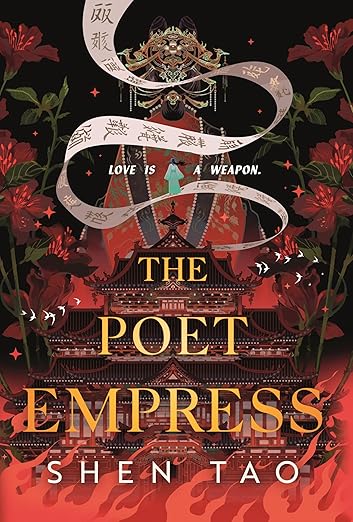
 I picked up this novel based on Narfna’s recommendation, and I’m glad I did. This is an intense fantasy novel about power, magic, literacy and women. And as Narfna says, it is NOT romantasy, no matter how it might be marketed. This is Shen Tao’s debut novel, and she warns readers that it contains violence, sexual abuse, and torture, and some of this involves children. It can be a lot but if you can handle it, it’s worth the ride.
The Poet Empress is set in a land is called Tensha, which is ruled by a patriarchal dynasty. Emperors’ faces are marked with a magical sigil that they were born with, and this sigil indicates some special power they possess. The emperor’s male heirs are not guaranteed to be born with a sigil and to ensure that there is a magical heir, emperors take on dozens of concubines as well as an empress. In this story, the Emperor has five sons, all marked with sigils, by five different women. One might assume that the eldest son would automatically become the next emperor but in this world, the emperor is free to choose any of his sons to inherit the throne. Naturally, this can lead to great, sometimes deadly, competitiveness amongst sons. Tensha is in decline due to hostile neighbors, war, famine and incompetent rulers. The Emperor’s health is in decline, and everyone knows that one of his two oldest sons — Maro or Terren — will become the next emperor. Many think it will be Maro, since he is the oldest and has used his road building power to create the Salt Road that has the potential to enrich the empire. But the Emperor names Terren, whose power is swords; Terren even as a child was able to wield this power to defeat some of Tensha’s fiercest enemies, but Terren is feared and despised. He is known for his deadly temper and has used his formidable magic to enchant himself with a spell that prevents anyone from harming him. He is, by all accounts, a monster.
There is another kind of magic in Tensha, one that is available to anyone — literacy. It is possible for one who is literate to generate magic with the written word if one is talented. The thing is, in Tensha, it is illegal for women and girls to be literate, and it is punishable by death. The most powerful women are those who are the Emperor’s concubines or the Empress, but their power is limited to their ability to get the Emperor’s attention and produce an heir. The women at court can be cutthroat (literally) with each other in their pursuit of power, but often their desire for power is rooted in their goals of helping their clan and specific family members back home.
In this violent world of political intrigue, clans form alliances and decide which heir they should support, and daughters are only valued if they become one of the Emperor’s concubines. These sometimes fatal political maneuverings are the domain of the elites, until a very unlikely young woman is introduced into it. Wei is a poor girl from a famine ravaged village far from the capital. Several of her younger siblings have died, and her parents struggle to keep Wei and her younger brother fed from the little that the land produces. When word arrives that a delegation from the Emperor will be traveling through their region in a search for concubines for the heir Terren, Wei puts herself forward in the hope that if she became a concubine, she could get food for her people and an education for her brother. The entire village supports this idea, but when the entourage comes through the local town, it seems unlikely that Wei will be chosen. City girls have the right clothing and manners, Wei does not. It seems laughable that Wei would be chosen until she is.
From here, Wei enters a new and dangerous world. Other concubines and the Empress find her beneath contempt and bully her, and it only gets worse when Terren chooses Wei to be his Empress once he becomes Emperor. Terren’s treatment (abuse and torture) of Wei is difficult to read, and Wei finds herself being drawn into the ugly side of court politics. Does she have to resort to violence and lying to survive? Does she want to? When she decides she will secretly learn to read so that she can cast spells to rid herself of her tyrant, a whole new world of intrigue and danger opens up.
As awful as the violence and torture episodes are, I was completely drawn into Wei’s story. Ultimately, in order to defeat her enemy, she has to completely know him and learn to love him, which sounds weird but Shen Tao makes it work. Wei’s struggles with trying to be a good person and trying to stay alive (meaning she has to do awful things sometimes) make her a complex character. She’s not perfectly “good,” but she is committed to something bigger than herself. The end is pretty thrilling, too. The Poet Empress is a wholly engrossing story about power, but take the trigger warnings seriously.
