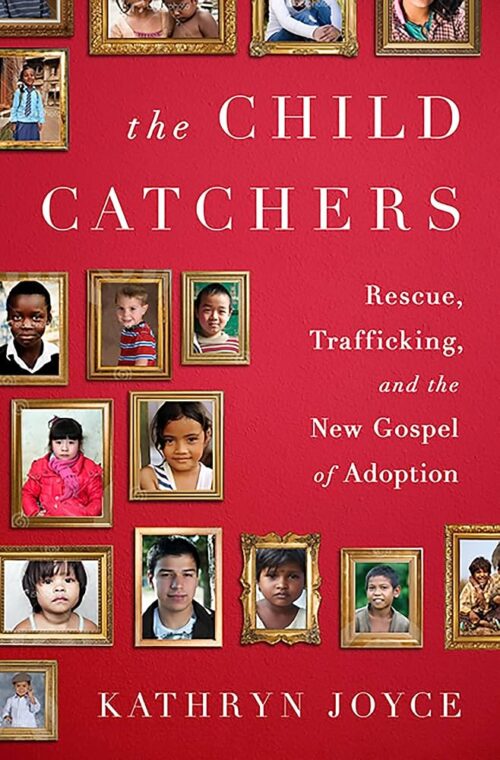
I grew up in a small town in the Midwest. It’s in a very religious area (the nearby city is literally nicknamed “City of Churches”), and one thing I noticed after I left was how many of my former classmates, after marrying and settling down, had adopted children from other countries. Offhand, I can think of 7 families I know in the area who adopted internationally, which in a small town seems like a lot. The Child Catchers helped me contextualize these adoptions within the broader framework of American evangelical Christianity.
In The Child Catchers, Kathryn Joyce explores the link between the evangelical Christianity and the boom in international adoption that occurred in the early aughts, before regulation caught up. Evangelical churches encouraged their members to adopt internationally in order to save orphans–but many of the children who were adopted weren’t actually orphans. Many of them had at least one living parent, if not a large extended family. This book is full of stories of children who came to the U.S., expecting to stay temporarily for education before returning home, only to be told that this was their new permanent home. Many of their parents, back in Haiti, Ethiopia, or Guatemala, were also unaware that they were agreeing to let their children move to the U.S. permanently. Oftentimes parents thought they were agreeing to a sort of guardianship of their children, a way for them to access greater opportunities, but under the impression that at some point their children would return.
Joyce makes an effort not to portray all of the adoptive parents in these stories as villains. Many of them were shocked to learn that the children they’d legally adopted still had living parents. Some parents tried to find ways to send the children back to their parents, only to be told by the courts that they were legally responsible for the child and couldn’t do that. The real villains in many cases were the adoption agencies, which would lie to both sets of parents in order to get money from the adoptive parents. Agencies–and sometimes adoptive parents who did know what was going on–took advantage of a lack of regulation around international adoption in some countries. Once a country began to organize and regulate international adoption, they would move on to a different country (When I think about the families I know from my hometown, this timeline of countries regulating adoption is clearly illustrated. The oldest children were adopted from Guatemala, with younger ones coming from Ethiopia or Liberia).
I think in general, adoption in the U.S. is viewed as a universal good. It benefits the child, it benefits the adoptive family and their community, and with international adoption, there’s no first family to worry about because children from overseas are “orphans.” The Child Catchers does an excellent job of dismantling these assumptions. It’s not an easy read, but it’s an important one. 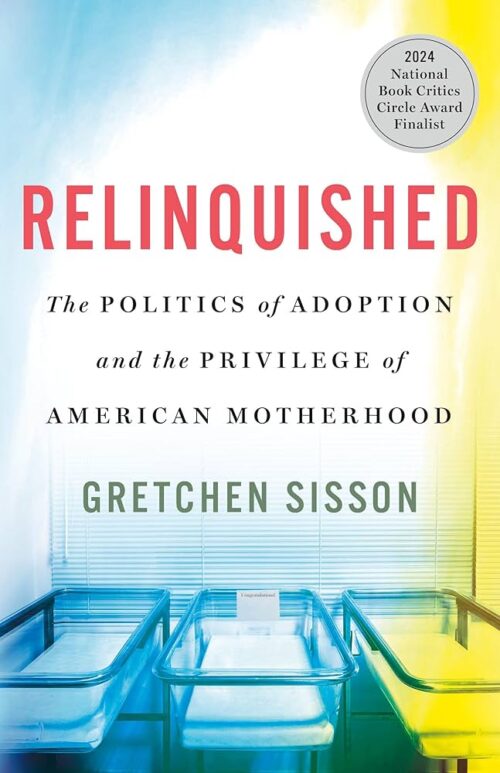
Speaking of books that are not easy reads! Relinquished is one of the hardest books I’ve ever read, because of how it challenged so many of my assumptions about adoption. While it wasn’t hard for me to accept the premise of The Child Catchers, I had to work harder to overcome my own biases and privileges for Relinquished.
While The Child Catchers focuses on international adoption, particularly within evangelical Christian communities, Relinquished focuses on domestic adoption, and looks almost entirely at the experiences of first mothers. Gretchen Sisson interviewed 77 first mothers about their experiences with adoption–why they chose it, how they felt at the time, and how they felt years later. The overarching messages are: women chose adoption because they felt like they had no other options, not because it was truly what they wanted. And how they felt at the time and years later was almost universally very, very negative. Almost every woman she spoke to regretted choosing adoption for their babies, and even the ones who didn’t regret it had a mostly negative feeling about it. Sisson argues that if Americans truly value family and children, then rather than encouraging women to choose adoption if they don’t feel able to parent, we should instead change our society to better support families so that women can feel able to parent, if they want to.
As I mentioned above I grew up in a very religious and conservative area, and even though I wasn’t raised in that tradition, one message I heard over and over while growing up there was that adoption is a viable alternative for anyone, and that it is the unselfish and brave choice with virtually no downside. This message is echoed in our popular culture where first mothers are proud of choosing adoption and never feel any regret, doubt, or sadness. These stories that center the adoptive family teach us to prioritize the adoptive parents’ experience over anyone else’s, including the child’s. Maybe the most important theme in Relinquished is the way it centers the experience of the first mother in a way that I haven’t seen done before. Sisson includes first-person accounts from several different first mothers. It’s a perspective that I think a lot of Americans could benefit from knowing more about.
Sisson asks us to reconsider the way we talk about and think about adoption. Every time adoption creates or benefits a family, it dismantles another one. It’s a difficult truth to swallow, but that doesn’t stop it from being true.
