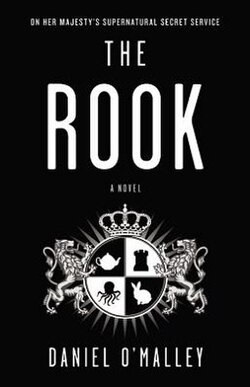
 Just last week I confessed that espionage is not my jam. This week I’m saying that espionage can be my jam if it contains vampires, flesh-absorbing monsters, and a kick-ass female protagonist. Shout out to MsWas for the recommendation. This book saved me when I was in a mini-slump!
A woman becomes conscious (I’m specifically avoiding the term “waking up”) in a London park with no memory of who she is or how she got there, surrounded by dead bodies, all of whom are wearing latex gloves. In her pockets, she finds two letters, an epi-pen, and a wallet containing all the usual “little plastic cards that are so vital for surviving in today’s electronic world.” The first letter is from the previous “owner” of the body the woman is inhabiting, one Myfanwy (rhymes with Tiffany) Thomas, and instructions to find a safe space before reading the second letter.
Upon reading letter #2, the new Myfanwy (whom I will hereafter refer to as simply “Myfanwy”) learns that she is a member of a British Secret Service called the Checquy Group (pronounced Sheck-Eh. This novel keeps you on your toes between the Welsh and French pronunciations.). The Checquy are sort of like MI-5, but they deal with supernatural threats, and all the members of the Court, of which Myfanwy is one, have special powers. Letter-writing Myfanwy confesses that, while she does indeed have special abilities, her real superpower is that she is an administrative genius. Through copious letters and detailed notes, she explains to her successor that someone on the Court is trying to kill her, and that person is responsible for wiping out Myfanwy’s memory. The remainder of this nearly 500-page novel has Myfanwy learning what her job is within the Checquy, finding the individual responsible for her near-murder, and uncovering a conspiracy.
Amnesiac secret agent is always a fun premise, but what I love most about this novel–even more than Alrich, the vampire Bishop on the Court, or Ingrid, Myfanwy’s uber-competent assistant–is that it flips the usual amnesiac script. Rather than a slow, dawning horror of what she used to be, Myfanwy embraces her power when she discovers it and turns out to be stronger and more confident than her predecessor. Her colleagues treat her with disdain, expecting her to cower and bend to their more dominant personalities, but when she first touches another member of the Court, she feels power coursing through her as she recognizes her unique abilities: “It was as if she had been plunged into a pool of water whose currents were winding their way around her. . . .Oh my God! Myfanwy thought. Suddenly, she had control over this man–not through violence but with all the force and power of her own mind. She was no longer defenseless; she was dangerous. Thomas, I can see why you were hesitant, but you never needed to be afraid of it!” My favorite moment is when a male member of the Checquy barrels up to her and invades her space and is stunned that she holds her ground rather than cringing or stepping back.
A female protagonist is great, but I also love that she’s not the token strong woman in this novel: Ingrid is a bit of a stereotypical admin who is on top of absolutely everything, but her character is enhanced by the warming relationship between herself and Myfanwy. Shantay Petoskey is a Bishop from the American version of the Checquy who ends up being Myfanwy’s first friend (note to Daniel O’Malley, an installment focusing on Shantay and the Croatoan wouldn’t be out of line). There’s also the sudden appearance of Bronwyn, allegedly Myfanwy’s long-lost sister. I was genuinely pleased that O’Malley took time to develop these relationships between the women in the story. Maybe that’s a low bar, but hey, props where props are deserved.
The Rook is a fun, engaging fantasy, part Bourne Identity and part Ghostbusters. I’ve already put the next two books on my TBR and can’t wait to see what’s next.
