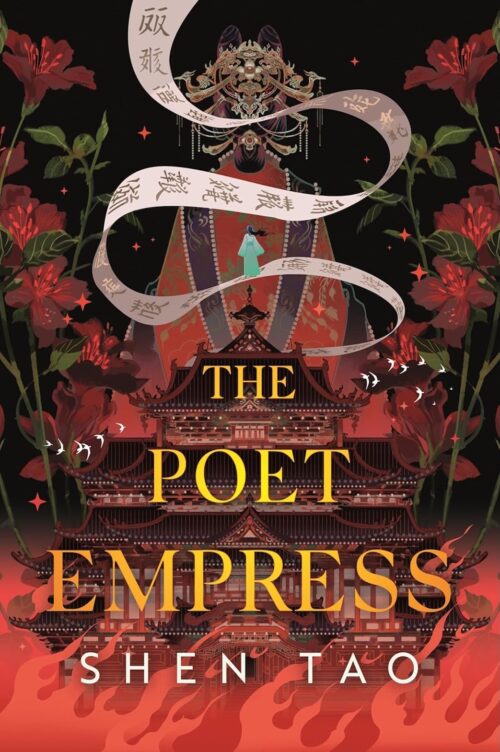
 Sending up the Bat Signal on this book, my first use of it this year. (FYI the last time I used it was with The Raven Scholar, my best book of 2025, so you know it’s serious.)
I wouldn’t recommend this book as widely or as often as I have The Raven Scholar, but for a certain type of reader, this thing will hit hard. (As it hit me. Last night, crying softly on my couch as I opined to myself, IT’S SO BEAUTIFUL.)
First thing’s first, THIS IS NOT A ROMANTASY. Whatever geniuses decided to market it that way (and Tor’s fantasy romance imprint Bramble published it?? for some reason???) are doing the book and its readers a huge disservice. Romantasy readers will go in expecting actual romantasy, and be nothing but disappointed (most likely). And lots of readers who need to be reading this book (readers of high and epic fantasy, court intrigue, and deep character studies) will not pick it up, because the label “romantasy” does not AT ALL convey what this book is.
The central premise here is that our main character, Wei, is from a very small village in the country of Tensha, which is ruled by a family of magical royals. The magic is passed on from father to son, but the birth of a sealed prince is extremely rare, so the Emperors always take thirty concubines and an Empress, hoping for the numbers to be on their side. Wei offers herself as concubine and is accepted almost by accident, but underneath she has a strong desire to help the people suffering all around her. The princes*, however, do not hold a monopoly on magic. Magic can be accessed by anyone through writing, and poetry. People called literomancers write Blessings that can be copied, and thus cast. Of course, to use this magic, you have to know how to read and write. Which women cannot do, on pain of death. Do you see where this is going.
*And do not think it’s not deliberate that only princes inherit magic; author has bones to pick with systems of power.
This is spoiler territory, so skip ahead if you want to be as unspoiled as possible, but I do want to get to the central premise here (which is in the blurb): Wei ends up taking it upon herself to write a very complex Blessing that would kill the unkillable prince Terren, a violent man with obscene amounts of power, such that even the most powerful in the court are afraid of him. But to write and use this blessing, it is said that you must love your intended victim, as only those who truly love a person are qualified to judge their right to live. Her quest to know Terren well enough to kill him was incredibly absorbing. And the Inner Court of Azalea House is a dangerous place, even without the murderous prince. Being there is dangerous, and watching Wei adapt and learn was one of the joys of the book. And as she learns, her understanding of the world, and her character, becomes so satisfyingly complex. At the end of the book, forty pages to go, I still wasn’t sure what kind of story I was reading, where it would go.
I really hope this review leads some people who otherwise would have been reluctant to read this book to pick it up and appreciating it as much as I do. I’m very happy to say this is almost certainly going on my best books of 2026 list. I can’t wait to see what this author writes next, if this is her debut.
