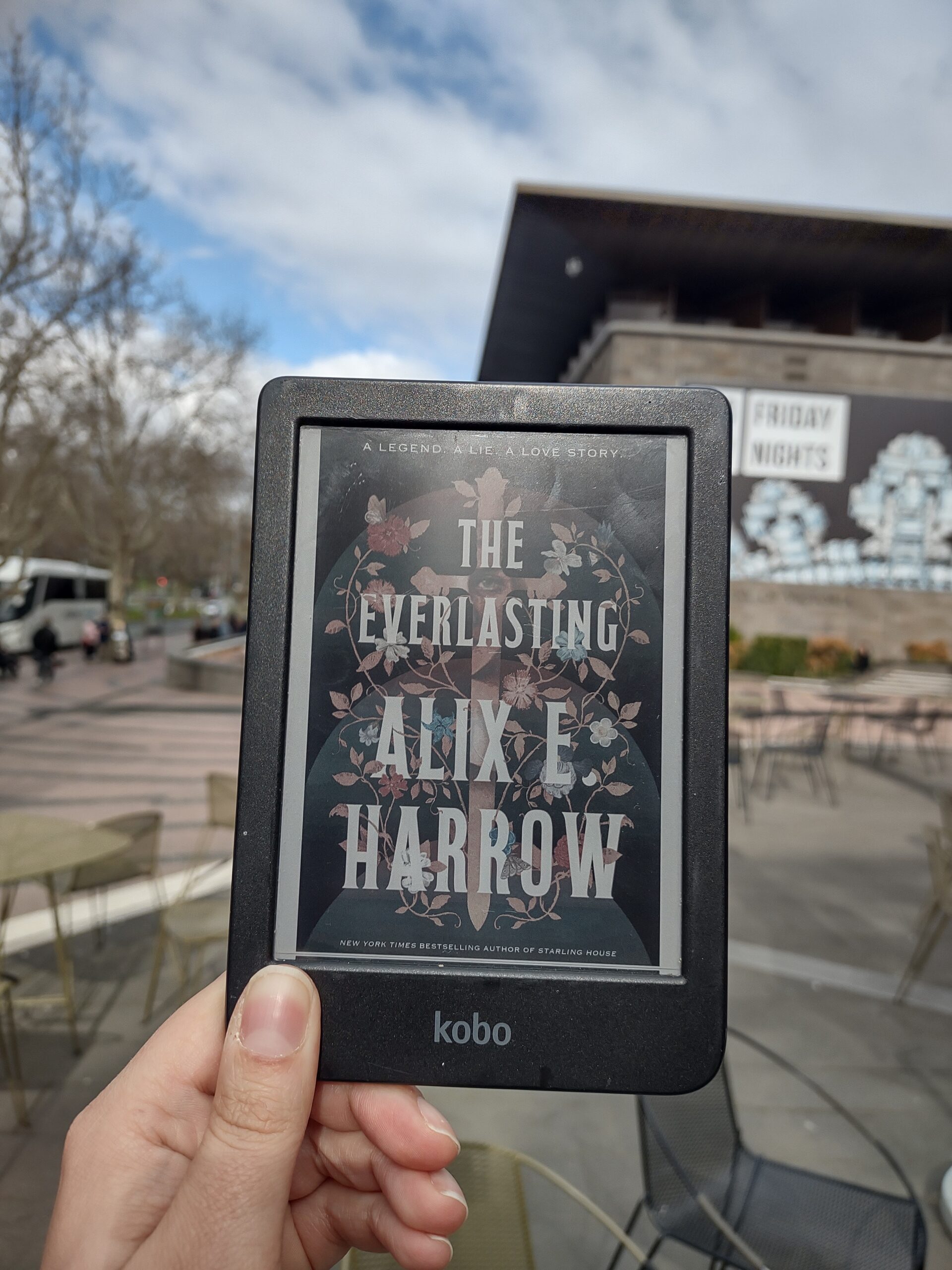
 Well good thing there was a bingo square for ‘Craft’ this year, because I have not read a book as well crafted as The Everlasting for a very long time. Alix E. Harrow has always been an ambitious writer, but here she really exceeds herself. The Everlasting is, at its core a love story, but I’m sort of reluctant to categorize it as just a romance; it’s so, so much more. Around it’s romantic core, it is a story about the power of myth-making, nationalism, and a deconstruction of certain well-worn tropes found in fantasy.
The Everlasting is written in the second person, from the perspectives of two people who have not yet met, but they will. Or perhaps they already have. Owen Mallory is an academic and a budding historian in the country of Dominion and his field of study is that of the country’s founding myth—that of Una Everlasting, the hero of the realm. The Queen’s Champion, the Red Knight, the Virgin Saint, the Drawn Blade of Dominion, the story of Una Everlasting plays a critical role in the national identity of the people of Dominion—which serves it’s purpose in times of war. Of which Dominion frequently finds itself.
Now, I have to point out there I nearly wrote ‘Albion’ instead of ‘Dominion’; like me, you should see the parallels to a certain famous legend straight away. It doesn’t stop there; Una is also famous for pulling a magical sword from a yew tree in order to slay a dragon, save the life of the beloved Queen Yvanne, and ensure a future for her the nation itself. However, as this legend tells it, Una herself does not survive.
Mallory himself has a very complicated relationship with his own identity and how it relates to his country’s mythos; as a veteran, some see him as a hero, but he believes himself to be a coward. As someone who tries to be a patriot, he seeks the approval of his government, but his actions deeply sadden his dissident father. So when Mallory receives a book in the post that claims to be a first-hand telling of the story of Una Everlasting, he is overcome. His academic supervisor, Prof Gilda Sawbridge, is very much not convinced of its authenticity, and is not afraid to let him know. I love the way Sawbridge and Mallory snipe at each other:
— “WOULD BE THE FIND OF THE CENTURY WERE IT NOT A CROCK OF SHIT WHICH OF COURSE IT IS”
—”ANALYSIS SUGGESTS IT IS AT LEAST A VERY OLD CROCK OF SHIT MAAM”
Also, one should be suspicious of random ‘ancient’ manuscripts sent in the post—smells like fraud, right? But before Mallory can decide whether or not he should act on the book, he receives an obscure summons from Vivian Rolfe, the Minister of War. She’s the one who sent the book, and she wants Mallory to be the man that tells the story of Una Everlasting. Mallory was expecting to just finish a translation; he wasn’t expecting to be the man making that first hand account. Meeting the real life Una means that Mallory has to come to terms with the fact that there was a woman behind the myth. He also has to deal with fact that he knows when she is going to die.
Our other viewpoint is Una Everlasting herself, and that pivot doesn’t come until nearly a third of the way through the book. In Mallory’s chapters, he’s slowly coming to terms with the fact that Una is a real person, not the symbol he’s placed on a pedestal—but once we see things from her vantage point, it’s clear he’s still seeing more myth than woman. And it’s not just Mallory: everyone Una crosses paths with in the kingdom treats her as something legendary, almost inhuman. She goes to battle time and time again for something she thinks she believes in—but does she still? A lady knight who could be seen as either a manly woman and a womanly man, a hero or a poor orphan child, it’s uncertain where Una might fit in the world if she weren’t a legend-in-life.
I really don’t want to give too much detail beyond this, because I don’t want to provide too many spoilers. But time does get shattered under one person’s heel, and we see the true power of myth and propaganda on nationalism—what happens if your foundational myths shift and change, time and time again? But like most time travel stories, the mechanics are washy at best; for enjoyments sake it’s not worth picking over too hard. As one character says: “[…] time travel is very fucking complicated, Corporal”
Despite the large-scale messages Harrow is weaving into her work, the core of the story is very intimate and character focused, with at most five characters truly fleshed out—but chiefly Mallory and Una. Their relationship clearly reads as a mature-aged one, and the manner in which they keep on meeting pushes the sense that time is always running out; lending both a degree of melancholy and an undercurrent of urgency to their interactions. Harrow is an expert at invoking this kind of intimacy while only rarely allowing things to become explicit; the one or two moments where she does are all the more powerful for just how sparingly they’re used.
Again, Harrow has written masterfully here, and this is one of the few books that in the last year or two that I have made time to read twice. The print edition has some very charming illustrations, but the audio edition is fantastic. This should come as no surprise, as Moria Quirk serves as Una-as-the-Narrator. But Sid Sagar as Owen Mallory is fucking phenomenal. Really one of those books served well by its audio version. I do think this might run away with the Hugo for Best Novel, if voters don’t get too hung up over the romance aspect.
For cbr18bingo, this one is Craft. Why? See above
