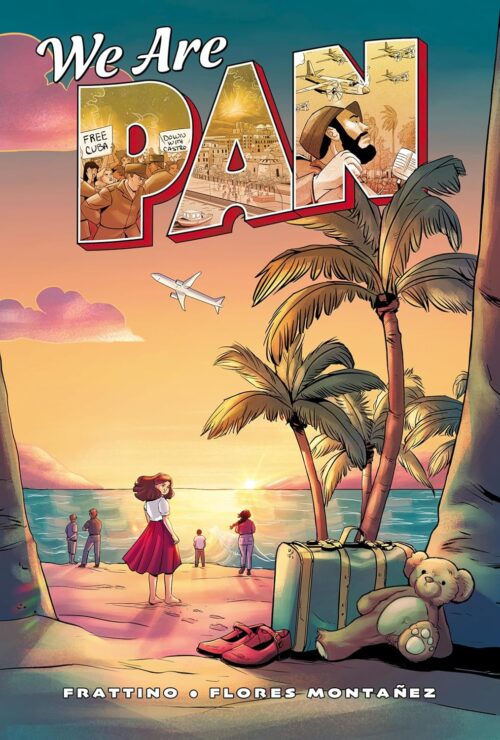
 A little over a year ago I read Tokyo Rose – Zero Hour by Andre R. Frattino and illustrator Kate Kasenow. I gave it a rating of four. When I was looking for my review from 2025, I found another review that was from 2023 (if you haven’t guessed, I came late to the party) on here that was also a four. I mention this other book because not only is it a great book and should be promoted when it can, Frattino is the author of my latest read, We Are Pan, which was illustrated by Yasmín Flores Montañez.
These two books have two main similarities: first, the obvious which is the same author and the second they are both historical events few if any really know about. The players were gone, didn’t want to talk about it, or it just got lost to life. Yet, they shouldn’t have. They are both thoughtful, moving, and interesting stories of people, everyday people, overcoming some of the biggest challenges of their lives.
I started reading via an online reader a few days before We Are Pan came out. I finished it a few days after it was out. I had one bump (the online reader format was not playing nice with my computer screen) but the lovely person who was the sender of my review link was able to hook me up another way. And that other way was perfect. Where I had struggled to read this powerhouse of a story of some of the children (a small margin of the thousands) would be part of the event before, I now flew. I had to stop, to pause, to take in how these children would be sent from their families in Cuba in the early 1960s to flee the impact of Castro’s Cuba. How the parents of these children sacrificed much: their health, their family unit, joining the military for privileges, even taking their own lives. How they thought and felt. What they loved and hated. What they embraced and what they feared. The revolution did not discriminate, but neighbors would turn on each other, old friends could not be trusted and the biggest decision of one’s life had to be made secretly in the open.
All the pieces of the puzzle come together in classic style of graphic novel illustrations. They are both busy, but allow you to focus on the main part of the story. Mostly featuring the five different children (of various ages, races, genders, and economic backgrounds), you get a picture of Cuba, its people, its politics, and the world at large. I give this graphic novel a five, not because it is the best book ever (though it is really good), because I can’t give it a 4.5 for tears. Yes, it made me cry. Not once, but twice! So, half a point for making my mascara run (if I wore any).