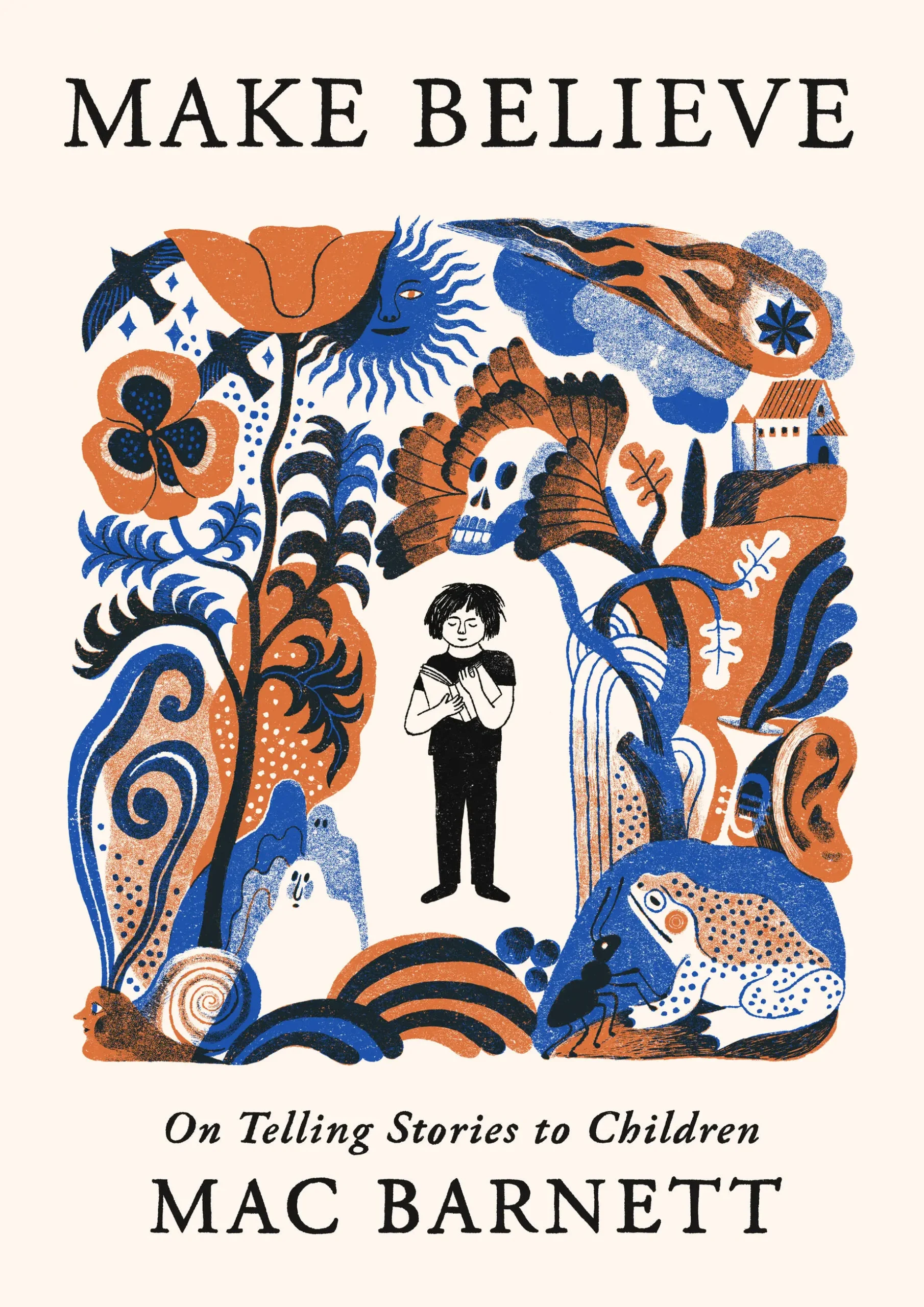
 Mac Barnett is one of my favorite picture book authors. My favorite book of his, The Important Thing About Margaret Wise Brown, is one of my favorite picture books period. I reviewed it here for this very reading challenge!
So I eagerly preordered my copy of Make Believe, his first book for adults, a book about the craft of writing for children. I got tickets to see the launch event of his book tour, a conversation with Jeff Kinney at Kinney’s indie bookstore in Plainville, MA.
That very day, authors of the kidlit community tore Barnett approximately ten thousand new assholes. See, a librarian — a librarian with a large online audience, I should add — posted a screencap of a divisive quote from his book, a quote that she said was her favorite part in the book. The quote, a quip that claimed most children’s books are “crud,” caused a lot of hurt among his colleagues in the kidlit world. Many librarians and booksellers are arguing on Barnett’s behalf, claiming stuff like, “This is a single line of a book taken out of context, why is everyone overreacting?”
But I don’t believe these children’s authors are overreacting. You can read a good summary of what went down at this School Library Journal article. (Hopefully, sometimes they paywall stuff.)
While I was digging into the discourse, I also read the book in question. My overall take-away is that Make Believe is a very readable discussion on the art of the picture book, with some wonderful points to be made about how we steward children to literature. But the book is marred by the dark cloud that is The Quote In Question and its surrounding chapter, and that is a damn shame.
Barnett comes to the picture book as a person who grew up reading classics from what he considers “the golden era of picture books” – the era of Maurice Sendak, Robert McCloskey, Arnold Lobel, and Barnett’s personal favorite (it seems): Margaret Wise Brown. He credits his mother with having raised him to regard picture books as not just a kids diversion, but an artform. When he was appointed to be the National Ambassador of Children’s Literature last year, he decided his focus would be to remind adults of the artistic merits of that art form and to encourage the industry to elevate it too. Here’s where his first argument starts to bum everyone out.
See, one of the problems of modern children’s literature, Barnett believes, is that most of it is garbage. Obviously, anyone who has stepped inside of a big box store and seen an endless row of 8 x 8 Paw Patrol, Frozen, and Barbie books where they would have liked to have seen actual literature understands he has a point. But he makes his point, in his words, in a “glib” manner, which ended up insulting most of his colleagues. The fact that he is a handsome white author with a lot of privilege, who has a habit of primarily working with white male illustrators, did not help. Especially when he criticizes his primary problem with most modern children’s literature, that of didacticism.
People have been arguing about the merits and problems of didactic children’s books since children’s books became a thing. Dr. Seuss is famous for deciding that children’s reading primers were boring when they needed to be fun, which is one reason The Cat in the Hat took off. I see similar debates come up when I tell fairy tales. People tend to think there’s always a lesson to be learned, because for a long time the industry has published fairy tales with “Lessons To Be Learned” in mind. Barnett believes this is one of the reasons we have a literacy crisis – that adults tend to give children books for the specific purpose of raising them into adulthood, rather than meeting them where they are at, letting reading be fun, and respecting children’s books as art.
The problem with this viewpoint is that attacks on didacticism in children’s books end up affecting books by marginalized authors most. Many parents will skip over a book about a black kid or a queer family or a disabled person because they don’t feel like “getting into all that” with their kid. Or they automatically assume it will be preachy. Barnett seems to have overlooked the fact that the issues and lessons that BIPOC and other marginalized authors explore in their books are issues that kids from those communities deal with in their everyday lives. It also seems to imply that he doesn’t do a very good job at reading his colleagues works – because I have rarely come away from a children’s book thinking “wow, that was super preachy.”
His focus on the “golden era” of picture books – a time when many writers of color wouldn’t have been published – only makes his ignorance in this area stand out more. That isn’t to say books from that era aren’t masterpieces: the ones still in print are in print for a reason, and he offers a really fascinating breakdown of what makes Goodnight Moon so much more than a bedtime story. Had he followed that up with an analysis of a modern, more diverse artful picture book like Watercress by Andrea Wang or Saturday by Oge Mora, maybe he wouldn’t have gotten quite as much flack. But he tends to focus on the oldies – he’s sort of a Wes Anderson-y type of guy in that way.
The reason I love The Important Thing About Margaret Wise Brown is that he depicts the life of Brown, a queer weirdo who related more to the kids she wrote for than the adults who taught them, with such grace. He showcases how Goodnight Moon was under-sung in its time; Adults didn’t get it, they found it creepy, and it was widely panned thanks in part to notorious librarian Anne Carroll Moore, who hated some of children’s literature’s most beloved classics.
Yes, you’re reading that right: an influential gatekeeper of children’s literature called Goodnight Moon garbage. The irony of Barnett quipping the same thing about his contemporaries, just a few year after he depicted that specific moment in literary history, is utterly wild to me.
And it’s really too bad. He clearly loves kids. He wants the best for them, and more than anything wants us to respect children as people, and not just future adults. He wants the industry to respect children’s literature in the same manner. He believes in a child-first focus in how we steer children to books. I think those arguments are needed, especially as he is representing an administration that has zero respect for children, who is actively hurting children, and actively trying to outlaw literature that empowers said children.
Unfortunately, that’s not what 94.7% of folks are going to take away from Make Believe.
