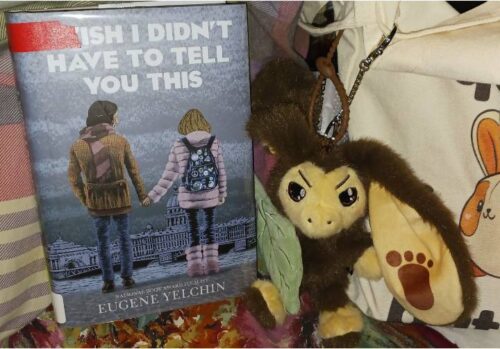
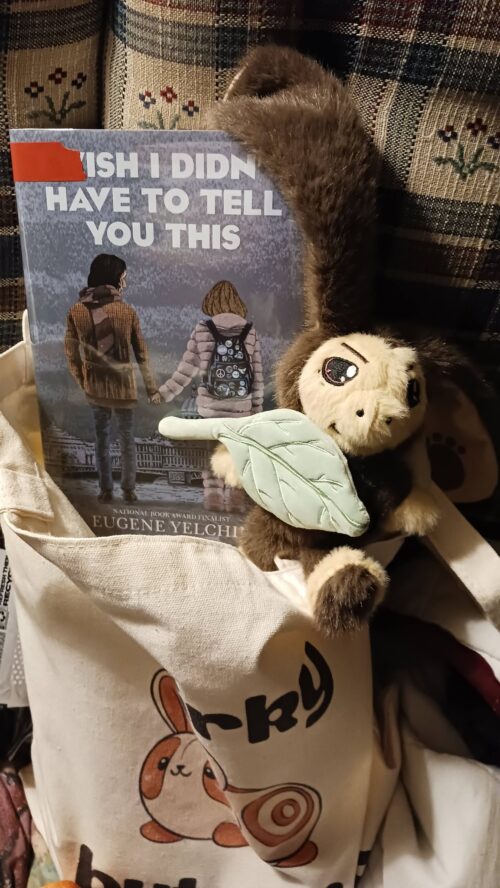
 I enjoy Eugene Yelchin as an author and illustrator. I have read several titles including, The Genius Under the Table: Growing Up Behind the Iron Curtain, Breaking Stalin’s Nose, and The Rooster Who Would Not Be Quiet! by Carmen Agra Deedy (illustrated by Yelchin). Therefore I was excited about I Wish I Didn’t Have to Tell You This: A Graphic Memoir written and illustrated by Yelchin. I was assuming it was going to be a memoir of his life during the early 1980s, but it is more of a fictional account of things that happened and probably happened to others. Therefore I can not say this is a pure autobiographical account. After all, (SPOILER) marries Libby in the Soviet Union and his real life wife is Mary, which is a big piece of information.
So, it reads as fiction, with a bit of memoir elements added. We follow our main character as he travels the city, dodging KGB, visiting friends, falling in love, trying not to be drafted into the military to fight in Afghanistan and ending up, “missing in action” or having a closed, square box sent home to his mother. Things follow what the atmosphere and times were about and maybe not as factual as I was hoping.
Still it is an overall interesting look at a piece of history most do not know about, even if one lived it. I was a young kid, not really aware of current events, but I like how we see how America was civilianized, like we were villainizing the Soviet Union (name me a villain in a movie at the time and most likely it was Russian). Clever illustrations grace the pages. They are both strong and have weaknesses. But that really made me enjoy things more. They have character and maybe not as expressive as I usually like, but they are not standing still. There is a type of action with them, even if we do not have traditional events that we consider “action packed.”
There are several potential triggers, therefore this is not for the audience of Genius or Stalin. It is for at least 13-14 to adults. Included, is talk of mental illness, death, stalking by KGB, and more, yet handled tastefully as even perhaps a bit conservatively, but does not hide what is happening. I found myself needing to slow down as it reads quickly, even when a point of the story is a bit slower. It reminds me of Uri Shulevitz’s story Chance: Escape from the Holocaust: Memories of a Refugee Childhood and The Sky Was My Blanket: A Young Man’s Journey Across Wartime Europe, but perhaps less intense.