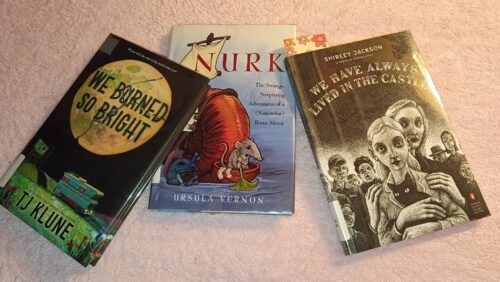
 We Have Always Lived in the Castle by Shirley Jackson has a lot going on in less than 200 pages. I had always assumed it was going to be a paranormal story, as people have always said it was scary. However, like Jackson’s story, The Lottery (the only other story by Jackson I know I have read), all the spooky and scary elements are psychological. We are scared because there are two women and their invalid uncle in a big, empty house with a town that hates them, and we are left to assume how that could boil over. This is because of the murders six years ago, and muddled information making you both assume that the murder was done by an “other” and not the oldest daughter, Constance, yet, concurrently there are very obvious elements to the truth.
Or at least for me, it was fairly easy to know the truth of things, but getting there is the journey. I both loved and hated everything about this book. If they haven’t created a graphic novel version, I think someone should. This book is ripe with elements that would add to the thrill with illustrations. Until then, I am left to wonder about our characters. How real are their personalities, descriptions and actions as we are being told about them from Mary Katherine, who is a young, selfish, unreliable narrator.
Rarely do I read forwards or afterwards if they are done by someone who is writing an essay about what you will be reading or just read. If it gives more information about things (facts on the author, setting, historical background, or biographical information is provided about a subject) I will read it. I almost was not going to read the afterward, but was curious about what Jonathan Lethem had to say. I think a lot of what Jackson wrote is about her commentary about the town she lived in at the time. Knowing people who are not from that area, they tend to look down on locals, and I always assumed that much of what was said about Jackson (because she was not a native) her commentary on “local small town people” was real. Jackson seems to have a background that would have lent itself for her to feel “above” the townsfolk; hence why so many of her stories seem to be “anti locals.” This feeling was only enhanced by what was written in Lethem’s afterwards. Therefore, she “don’t like them” and “they don’t like her” was a natural situation to occur in reality and books. And one will never really know who “started it.” But she shows it with her writings.
All the personal experiences (hers and mine) placed into her story and my feelings about that, make me dislike her characters (though I think I would have even without my bias). I cannot like any of the characters, not even poor, daffy Uncle Julian, who might be the least offensive character. But DAMN! Can that woman write!
