This year, I picked up tennis for a number of reasons. Chief among them: a realisation that I would always feel a pang of insecurity when confronted with someone who rudely knew how to play tennis, even though I did not. (This impulse has driven me to learn several new languages and sports.)
At first, the group lessons were extraordinary fun. I would come home grinning, feeling like a dog finally let off leash to play. However, after a few months, something soured. I noticed myself acting unpleasantly towards the more competitive students (even though I myself am competitive). I was also reaching a plateau. That’s when I reached for The Inner Game of Tennis by W. Timothy Gallwey for a fresh perspective.
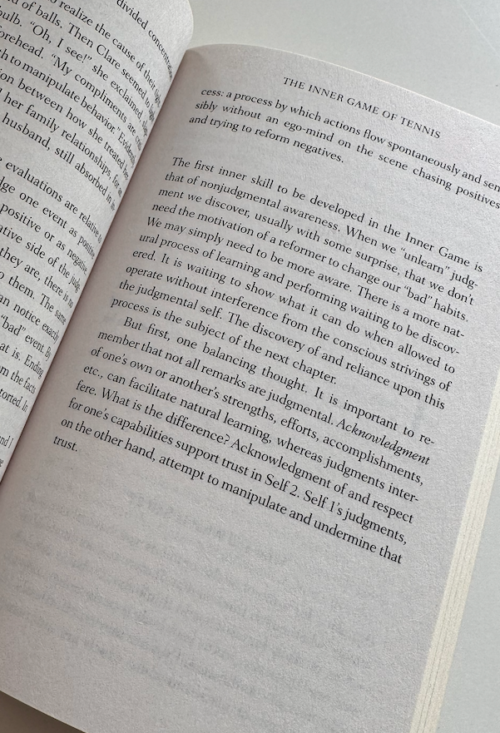
Gallwey’s thesis is that learning is a natural process. It is aided by relaxed concentration and self-confidence, but inhibited by self-talk (both positive and negative). This is the inner game: the achievement of relaxed concentration. The outer game of tennis is most effortlessly conquered by those who simply let go. In other words, when it comes to learning, trying hard is a questionable virtue.
The majority of the argument proceeds through Gallwey’s theory of the two selves. “Listen to the way the players talk to themselves on court,” he writes. For example: “lower your racket,” “bend your knees,” “try to meet the ball in front of you,” etc. But who is the player talking to? They are talking to themselves, of course. It is a one-way dialogue between a “teller” (Self 1) and a “doer” (Self 2).
These commands are endless, monotonous, critical, and absolutely unnecessary. It demonstrates a lack of self-trust: the player does not trust their body (Self 2) to perceive and react appropriately.
“Think of how Self 2 must feel! It seems as though Self 1 thinks Self 2 doesn’t hear well, or has a short memory, or is stupid. The truth is, of course, that Self 2, which includes the unconscious mind and nervous system, hears everything, never forgets anything, and is anything but stupid.”
Gallwey illustrates this theory with several examples from his long career as a tennis coach. Much like his new teaching strategy, these follow the maxim of showing, not telling.
Further in the book: an argument against the trope of “positive thinking”; the importance of competing earnestly to show respect; the nature of stress itself; and (in the weakest chapter) the “other games” people play on court.
The conclusion seems to be that almost all teaching, no matter how gentle, is over-teaching. This is especially true when inflicted upon a student who is already trying too hard. The answer, Gallwey proposes, is to loosen our grip.