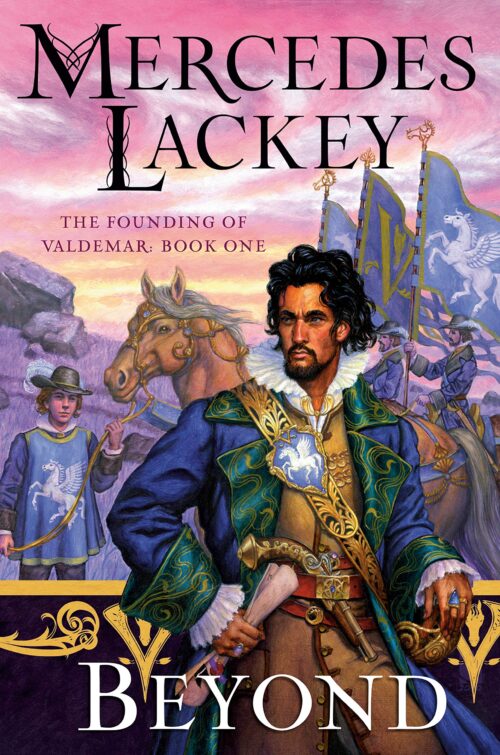
 Kordas, Duke of Valdemar, allows the Empire to consider him a country bumpkin and buffoon. It’s a useful ruse that protects him and his people from the cutthroat politics of the empire. His family has been developing a plan for years to get his people away from the Empire, and now it is almost time to put the plan in motion. However, developments from the capitol throw the plan into gear early and a number of new variables are added, but Kordas knows that this is his people’s best chance to escape the Empire and have a chance at freedom.
This series was an exercise in frustration for me on a couple of different levels. This is a story that I have always been curious about, and long time readers of the Velgarth books have gotten snippets about off and on throughout the series. However, that may have done this particular series a disservice as I found it to be a disappointing tale over all. There were definitely interesting ideas there, but the execution I found to be lacking. The first book wasn’t a bad start to things. It did a good job of establishing both the world and Kordas as a character. Parts of the end seemed a little rushed, but mostly it worked really well. The spanners that got thrown in the works helped moved the story along and added to the overall plot. The second book picks up not long after the first book ends. And this is where the trouble starts.
Admittedly, Kordas has been through a lot, and it is very clear that his experiences in the capital from the first book are effecting him. And there is a of difference in the sort of leadership need now that they have escaped and are looking at building a new home. Kordas is one of my biggest problems with these books. He’s likable enough in the first book, but he becomes harder and harder to feel that sympathetic for him. I don’t mind a guile hero who uses deceit and cunning to reach their goals. Nor do I necessarily need him to have all the answers. Dealing with his self-doubt on a regular basis was exhausting, especially since his actions make clear that he’s essentially a moral person. Sure, he grew up in the Empire and has definitely played the game to a certain extent, but his actions have never showed him to be the same sort of person as most of the Imperial nobles. And every single time that the thought of behaving like the Empire comes up in his head, he dismisses it. I can believe that he might have doubts, but the amount of time spent on them was deeply annoying.
I did also get frustrated with how Delia’s character was developed though. Her infatuation with Kordas makes perfect sense given her circumstances, and the fact that she is not let in on the plan to escape the empire until the last minute didn’t help things; but she did step up to her responsibilities. I was hoping once the first book was over with she’d get to really come into her own more, but that didn’t really happen. Part of the issue is that she never really gets a place or job of her own; she’s almost always attached to her sister and brother-in-law, which doesn’t help her unrequited crush on Kordas, and most of the work she’s assigned doesn’t necessarily speak to her talents. She seems very much an afterthought to Kordas and his family, but she really isn’t given any other tasks until she gets sent with the scouts.
While I’m glad that we continued to get her point of view throughout the books, I sort of feel like she should have become more of the focus character than Kordas, especially as things moved past the initial escape. Delia is a much more sympathetic character to my mind, even if the length of time it takes her to develop past her infatuation with Kordas and settle into herself seems excessive. It’s also annoying that she completely disappears as a point of view character in book three. While her replacement, Restil, is a great addition, we didn’t exactly get a satisfying end to her story, in part because she is still pretty present in the narrative. Kordas at least mellowed in the third book, but I still found that his point of view was the least helpful and interesting.
The Dolls are an interesting addition to the setting, and they worked very well in the first book. However, as events continued, they began to feel more and more of a deus ex machina, and I think Lacky sort of wrote herself into a corner with them. The decision to remove them from the story was the right one and made for some good challenges for the Valdemar convoy. I also found it interesting to see magic that worked in ways that were not typical to the other books in the series. I’m trying to avoid too many spoilers, so there are a couple of things that didn’t work for me in the later books that I’m not going to elaborate on, but these books were very much a mixed bag for me and a particularly uneven one at that. I also felt that the third book rushed its ending and set up a number of plot threats that could make for interesting future installments, though overall it was a much stronger outing for the series, and the ending was a good one if not completely satisfying.
I wasn’t exactly expecting a perfectly tidy start to the country of Valdemar or necessarily a heroic tale, but this trilogy just didn’t work for me. I thought that it started strong, but that the story lost focus and the characters didn’t hold me by the end. While there were some really good moments throughout the books, this trilogy is one of Lackey’s rare misses for me. They’re not bad books by any means but I did find them to a disappointment overall, and they didn’t really work as a trilogy. It’s the second book that really lets things down. We could have actually jumped from the first book to the third book with no problems. Beyond gets four out of five stars. Into the West gets two out of five stars. Valdemar gets four out of five stars. As a whole, the trilogy gets three out of five stars.
Bingo – Clown – Kordas acts like a clown to deceive his enemies.
