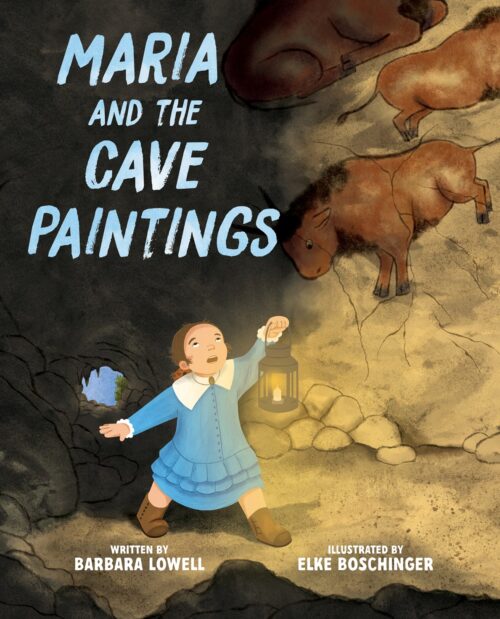
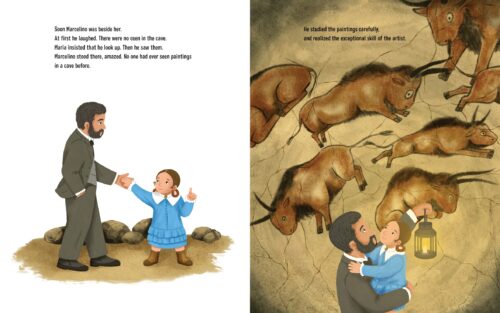
 A while back I read Maria and the Cave Paintings by Barbara Lowell and Elke Boschinger (due early November 2026; via online reader). This book shows how a child, with her father, explores a local cave of Spain. She wanders off on her own, coming upon paintings on the walls of the cave. Her father is convinced they are prehistoric. Though things are exciting, at first (as it is the 1880s and one of the first discoveries of such things), over time, the pull of the caves diminishes when it is “proven” the paintings are “too good to be true.” There is no way a “prehistoric man” was “good enough” to do this level of work. It would not be until decades later (1905 in fact) that proof came from France that these findings were real. And while the father was no longer with us, Maria was, and she got her apology from the man who started the doubt.
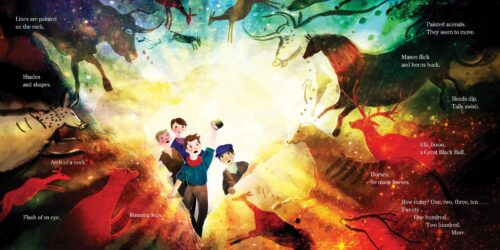
There would be more evidence in the decades to come about prehistoric imagery on cave walls. Like What Marcel Found: The Incredible Discovery of the Lascaux Cave Paintings in the early 1940s as France was in the middle of World War Two. This time the author Cedar Pruitt and illustrator David Litchfield follow a young boy and how he finds paintings hidden deep underground. He then lets a few friends in on the find, even having a picnic among the artwork underground. And finally letting a teacher and the world learn of this find. The story and images and this piece of history represent the hope and beauty there can be among the destruction of war. This book is due soon, in October 2026and also read via an online reader. 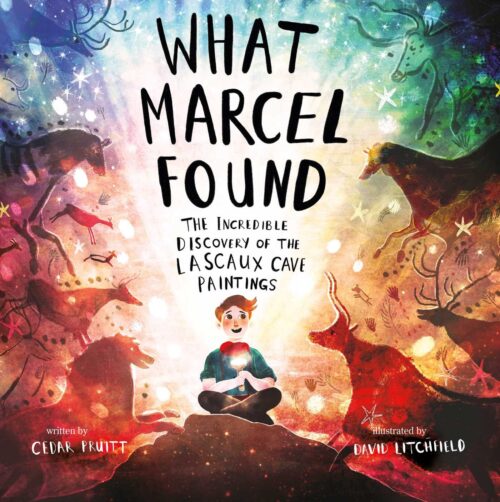
What both of these have in common is the idea of how painting and art can tell us so much about history that has no real written record. What they have are different images. Boschinger created sweet, bright, but soft, and slightly on the simpler looking side of things. They look young and the story is for that young to middle young pre-reading to just starting to read ages. Whereas Litchfield made images that made me say, “Wow!” Rich, deep, detailed colors and both dark with light poking where it can. They are emotional, heavy and yet, not depressing. They are more on the “adult looking” side of things, and that also reflects the story which runs more to the five and up crowd.
Maria is a fun introduction to another piece of history, women’s history and art. Marcel is a neat introduction to art and hope. There is little in the way of history in the stories, but there are extras to help fill in a few gaps.