 Back in July I had some vacation time which I took so I could be with my oldest nephew for his birthday (somehow ice cream tastes sweeter when you share it with him), do some adult (by my standards) reading, and take time to think about what I read, could be reading and will read. Especially in my “out of wheelhouse” category, which actually occurred with some official comic book reading but (maybe) more on that later.
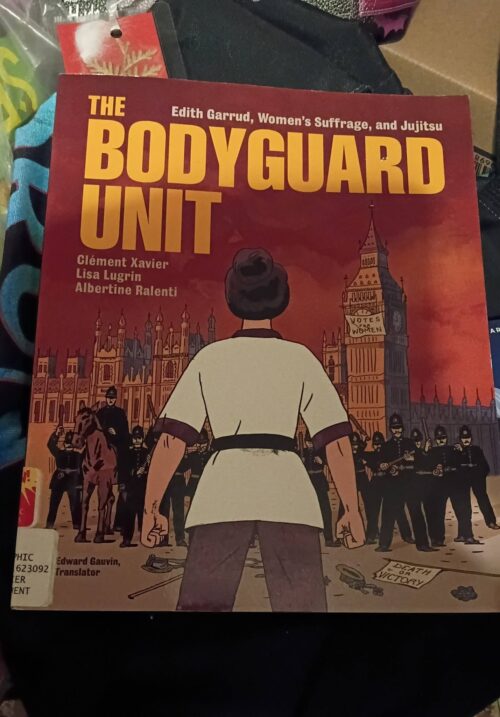
The Bodyguard Unit: Edith Garrud, Women’s Suffrage, and Jujitsu by Clément Xavier, Lisa Lugrin, Edward Gauvin (Translator), and Albertine Ralenti (Colorist) was one of the books I was able to read. It was an interlibrary loan that I had forgotten I had requested. Maybe that accounts for when I started reading, I really couldn’t “get into things” right away. This is a book where you need to be in the right mind set, the right comfy reading spot, no distractions and an open mind. I skipped most of the introduction as I didn’t want to be influenced by what was being said. The theme, I figured, was going to be interesting, but I was not sure what to think of women suffragettes and martial arts or defense. I had some cultural and time biases; I mean sure in this day and age, women are out exercising or doing defense arts and we think nothing of it, but in that time? England? Husbands “let” their wives do this? And those thoughts are exactly why we all need to read as well, it had to start somewhere and this was as good as any time to start.
The way we’ve been taught the suffragette movement is only part of the picture, we miss this part: the women who became body guards to some of the most important leaders of the movement. How these women were learning how to get free of the stark life of a wife with no rights. The history of people unfolds on the pages.
The non-fiction elements are woven into a fiction format to make the story flow. The overall takeaway is that this is a good book for introducing the themes. Personally, I would have liked a bit more background in the text about the real life people, however, the extras at the end help fill in a few holes. Simpler, but not simplistic, detailed supporting illustrations enhance the material, tying it all together. We learn how a husband and wife team start a school for anyone to learn jujitsu. It was able to happen because at the time Asian arts were considered “less than” and therefore nothing to worry about, and therefore, let the women have their fun. Little did they know that the students would learn discipline, comradery and how to protect themselves when their husband threw that punch.
