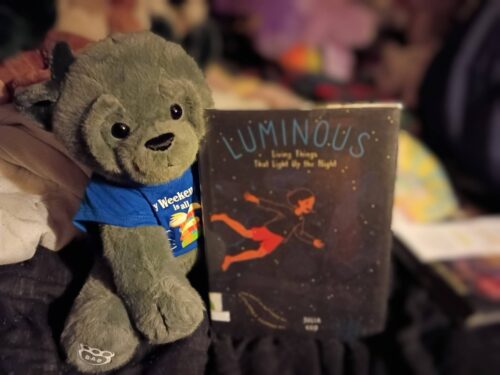
 My new goal is to find as many books I can find that are written and illustrated by Julia Kuo. I have read only a few, but know that I won’t be disappointed when I find others. The one that I recently found and has sealed the deal for knowing I will enjoy their books, was Luminous: Living Things That Light Up the Night by them. And all I can really say is that this is just amazingly and beautifully done. Overall, it starts out for the younger crowd, but allows all ages to participate in it. You need to read it three times. Once for the shorter poem; once for the poem and the extra facts, and the third time for the images.
This book is the first of a (so far) two book series called I Am Nature. The second is Mountainous (which I have already reviewed). Both books take a piece of science and make it both fact and fiction. The first part of things is that there is one line per page poem or poetry sentence that flows onto the next page. Usually it is only a few words, but it allows us to feel the artistry and poeticness of the subject. The second part is adding scientific facts in a short paragraph off to the side. These two combine to allow the book to adapt to the reader by aging along with them.
When the two pieces are combined, I enjoyed how you can read that short line on each page and get a story. You then can read that line on the page combined with the facts and that, too, is a poem which does not really flow to the next page, but allows each one to be its own section. And finally, there are the illustrations.
These images differ between the two books, with Luminous we focus on the night and ocean, and Mountainous deals with the land and mountain. The narrator asks what could happen if we had an inner light that literally showed out of us, like the creatures and elements that are out at night or in the deepest parts of the ocean. We see things from fireflies to the vampire squid and how each one uses forms of light to be predator or not to become prey. Of course, some are large and others cannot really be seen with the naked eyes, unless thousands are together, so it is busy with how many species we can discover. The pages are mostly a chalkboard black with some colors to accent a piece of things. However, mostly things are deceptively simplistic looking, yet are not.
