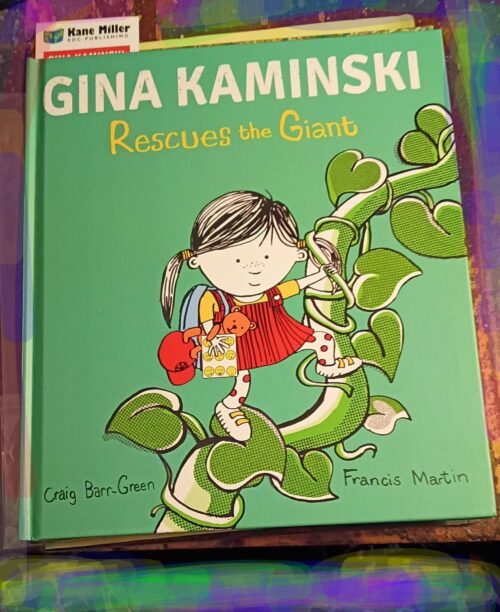
 I have read Gina Kaminski Rescues the Giant by Craig Barr-Green (at least) twice. The first time (though it is out) was an online reader copy. And I wasn’t really sure how I felt about things. The second time I started to get into it more (another online read). I have also skimmed it, and skimmed Gina Kaminski Saves the Wolf (another book starring Gina). I then won a copy from the publisher. I skimmed it that day. I know I will read it again. There is something about it that draws me. Maybe it is because these books are about a neurodivergent child, Gina, who like many on the spectrum has a lot of situations that she must deal with and finds her own special way to do so, and I see that with my own experiences with people like her.
Gina’s books have a pattern: She is neurodivergent. Too many directions or over-stimulation can cause anxiety. Not knowing the pattern or the routine makes her feel off and that’s not good. But what is also not good is the fact when she reads a book, it has three problems that Gina feels it is up to her to solve them. A good situation make Gina cozy and your reader will be cozy while dealing with the issues along with Gina. Like many neurodivergent children she has issues with expressing feelings so she uses a chart so when a situation happens (the museum trip is causing anxiety), her chart comes out, helps her explain feelings and she and her aide can fix them. In this book they head into another room away from the busy events. The aide asks which book she wants to read, she has trouble deciding, so her aide’s choice is Jack and the Beanstalk. But she notices problems like getting just beans for a cow, stealing from the giant and hurting the giant is wrong, so she must fix them. We then find her fixing each issue with clever logic. This highlights our characters personality. No, we don’t get some “big life lesson” but the smaller picture shows our neurodivergent children, giving them representation.
This is cute, clever, and solid. But at first the tone was off for me. It wasn’t my pattern. But the second time I realized that this was a good tone. I know several listeners who would relate to things. And that is what really makes things work. Also making things work is Francis Martin and their illustrations. You can judge the book by the cover (up to a point). Things are muted colors and details, but things are going on. You can just enjoy them, make up your own story. Everything is nice, but not WOW for me, but good for the right reader.
