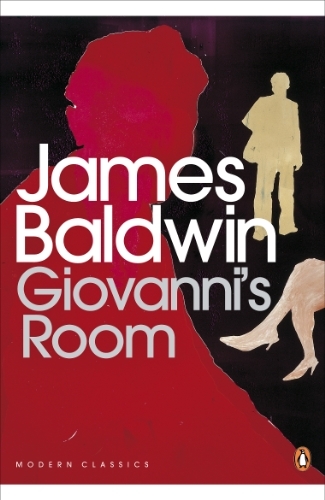
 CBR Bingo: Wheel, mainly for the cyclic nature of David’s relationship with Giovanni (and Hella) post- the idyllic room bit, where he goes around and around about what he wants
A short, bittersweet plot about David, an Américain in Paris in the late 50s/early 60s (I think) who is nominally engaged to a modern lady who is currently in Spain trying to figure out if she loves David enough to get married. They’re very open minded, you see, until Hella realizes all she wants is to be a kept woman and have babies. But we’ll leave that aside for now–David is perpetually broke and manages it through a combination of begging his father for money and having dinner with ostentatiously rich older gay men in front of whom he sort of dangles his bisexuality (not that he’d call it such). One night, he meets Giovanni, an Italian expat who’s even poorer, and goes home with him to the eponymous Room on account of not having enough to settle his hotel bill. They proceed to live in a little bisexual bubble until two things happen: one, Giovanni makes David a tuna melt and David runs away develops feelings and expresses them in his Dramatic Italian Way and two, Hella returns and David decides it’s time to do Compulsive Heterosexuality. We know we’ll end with Giovanni executed for an unknown crime (it’s in the first chapter) but how we get there and how David will square away his feelings is the name of the game.
This can’t be any less than four stars, I feel, but boy did I not dislike some parts immensely. Like, so much so that I wanted to just reach through and throttle Baldwin-as-David (?), or so much that I started thinking about old arguments around misogyny in the gay (masc) community. It’s a different era, you say, living forever closeted and in fear of your life, you say, poverty makes people do wild things, you say, but also I can read a book from another period and just flat out dislike some attitudes that we no longer tolerate, right? There’s an entire section where David spews some vile anti-drag language that wouldn’t seem out of place in today’s MAGA Twitterverse (I was about to make a joke in the form of “language that even [MAGA influencer] would call a bit much,” but then I realized that such a person no longer exists. 2026, people!) and sure, it’s all because he’s got some self-hate that he has to deal with and studiously avoids but also like, pass bro.
But nestled within all of that is some beautiful observational writing by Baldwin on what it means to travel and wander, as David is doing:
I ached abruptly, intolerably, with a longing to go home; not to that hotel, in one of the alleys of Paris, where the concierge barred the way with my unpaid bill; but home, home across the ocean, to things and people I knew and understood; to those things, those places, those people which I would always, helplessly, and in whatever bitterness of spirit, love above all else. I had never realized such a sentiment in myself before, and it frightened me. I saw myself, sharply, as a wanderer, an adventurer, rocking through the world, unanchored.
And then some sharp insights from Giovanni on why David feels as such:
He smiled, “Why, you will go home and then you will find that home is not home anymore. Then you will really be in trouble. As long as you stay here, you can always think: One day I will go home.” He played with my thumb and grinned. “N’est-ce pas?
And sue me, as an expat/immigrant in a foreign land I’m a sucker for well observed commentary about my experience.
There’s also a tenderness in how Baldwin skips over, let’s say, prurient details (what today we’d consider par for the course for a M/M romance, of course). We don’t really get romantic interludes of what goes on during the late-winter-to-mid-summer that David and Giovanni spend in their little room, being best boy pals. And I choose to think it’s because a) it’s better to leave it to the reader to fill in, with their own experiences of heady, intense love and b) amongst all the ugliness, it’s almost nicer not to have to nestle something beautiful.
End of day, despite everything I’m left with a lot of empathy for this sad, IRL mirror to Cat Sebastian’s 50s M/M romances. David’s latent homophobia is a poison that he cannot fix in time to salvage what he has with Giovanni, and if I’m being honest I don’t think he’ll fix it before his marriage to a nice woman back home in the US with whom he has 2.3 kids and a white picket fence. After a year of reading/consuming a LOT of uplifting, joyful queer (male) romance, this book hit hard.
