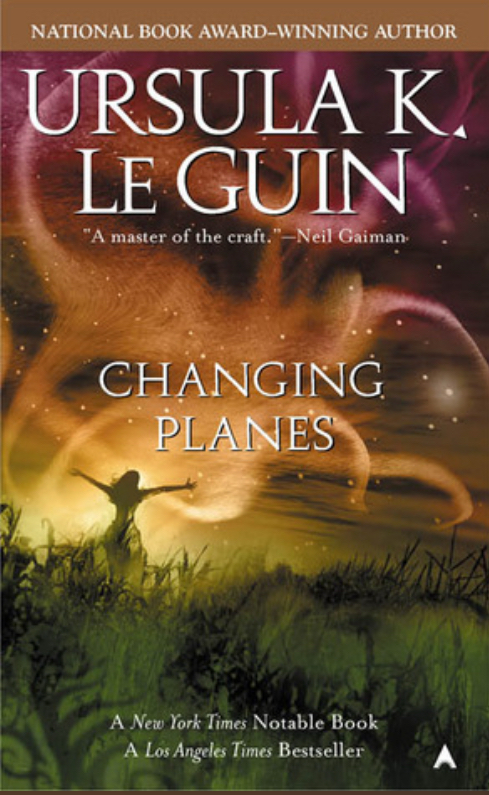
Bingo Square: Or (this collection explores alternate planes of existence and inter-dimensional travel)
Quotes:
“Although his campaign had become increasingly outspoken against “godless” and “foreign” elements of Obtrian society, many Astasa voted for him. They wanted a strong leader, they said. They wanted a man who would stand up against the Vens and restore law and order to the cities, which were suffering from overpopulation and uncontrolled mercantilism.” – from “Woeful Tales from Mahigul”
“the Islai had been strong on practical physics, agriculture, architecture, urban development, engineering, invention, but weak in the life sciences, history, and theory. They had their Edisons and Fords but no Darwin, no Mendel. When their airports got to be just like ours, if not worse, they began to travel between planes; and on some plane, about a hundred years ago, one of their scientists discovered applied genetics. He brought it home. It fascinated them. They promptly mastered its principles. Or perhaps they had not quite mastered them before they started applying them to every life-form within reach.” – from “Porridge on Islac”
Ursual K. Le Guin has always felt like a bit of an odd gap in my reading (I have read most of Octavia Butler, and have read the Foundation books – at least the first 3 and yet, not much Le Guin). It’s not that I haven’t read her at all: I read and enjoyed The Left Hand of Darkness, and also picked up a random essay collection of hers from 2017, No Time to Spare. It’s just that none of them have really made me want to read more. This is the August Buffering book club selection, and I’m guessing is probably not the best choice to change my mind. Another collection from later in her career (2003), I think I need to go back to her earlier books to truly appreciate her. And the fact that this is kind of a short story collection doesn’t help because I tend to prefer novels. Now the disclaimer is because this collection is less of a short story collection and more of a fictional travelogue.
The collection begins with an explanation of how Sita Dulip discovered interdimensional travel while suffering through an extended layover and missed flight at the airport, and then follows up with 15 chapters, focused on different planes. For the most part, these are descriptions of the lands, people and habits from the narrator’s perspective though some have a bit more narrative to them, such as “Woeful Tales from Mahigul” which highlights stories from history of that plane.
The snap shots are also a mix of fascinating sci-fi worlds and ideas I would like to explore more (“The Building” is set in a world many centuries after a population explosion led to a collapse and has a group building a mysterious building for very undefined reasons that I would have loved to see come to fruition), inspiration from nature (“Seasons of the Ansarac” was my favorite of the collection and also the longest, inspired by migratory patterns of osprey), and finally social commentary on our world or the places it might go, from “Porridge on Islac,” (the second quote is from that piece and very much a condemnation of science without thought), “Great Joy,” (very much a condemnation of capitalism and the obsession with resorts and holidays as this one covers a plane filled with holiday themed islands and an economy based on the exploitation of the local people’s labor), and “The Royals of Hegn” (let’s just say Le Guin would have hated influencers).
Most of these are rather short (around 10 pages or less in my edition, with the longest being 16 pages), there were quite a few I didn’t really enjoy, including the one about collective dreaming. Her social commentary was insightful and interesting, but in some places felt a bit harsh. I saw the blurb for the essay collection I mentioned had described her writing as acerbic, and I wonder if that is why I haven’t connected with her more as an author this far: while I agree with many of her takes and social observations/concerns, her sharp wit also keeps me at a remove as a reader. She’s intellectually engaging but I want more of an emotional pull as well? But that’s also why I need to stop reading her collections of shorter works, whether non-fiction or fiction, and read a full length novel to give her writing the time to do both. The travel descriptions are also all accompanied by one drawing, some of which are a bit disturbing.
