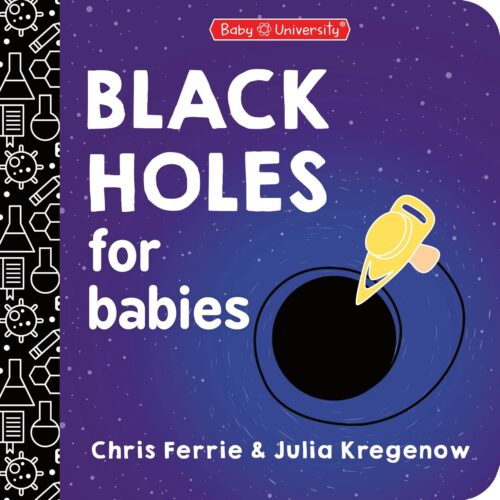
 Black Holes for Babies by Chris Ferrie and Julia Kregenow PhD (read via an online reader and due in November 2026) would be great for up to second grade or to help an older student organize their thoughts and understanding on the subject. However, if it is like others I have seen in the Baby University series, the slightly oversized board book format might turn those older readers off. However, I am not positive of the final form and hope the adults (parent, teacher, aunt, uncle, grandparent, etc) can work with them to see how it can work for them. Regardless, it has a Wealth (Bingo!) of knowledge.
I am positive that it is a good book, and that is not just because the publisher description says so, or says: a playful, accessible introduction to one of the most fascinating mysteries in the universe written by people in the field. It is not because of anything other than the fact that it is in accessible language and bold graphics to explain how stars collapse, how gravity works, and what makes a black hole “black” makes it good. I was able to understand the basic information, sure, there were still a few areas I was not completely “there with the authors” but that just means I get to explore more.
The illustrations are either a hit or miss for you. They are not overly detailed, which is good, as you can concentrate on the concept in front of you, but sometimes more would have been better.
Included in the Baby University books are ABCs of Artificial Intelligence, Quantum Physics for Babies, Astrophysics for Babies, Calculus for Babies and even Organic Chemistry for Babies. Not to mention (but will) Rocket Science for Babies, Newtonian Physics for Babies, General Relativity for Babies and things I’ve never even heard of. So, Ferrie has you and your children covered with approximately 40 different titles for you to read.
cbr18bingo Wealth of knowledge
