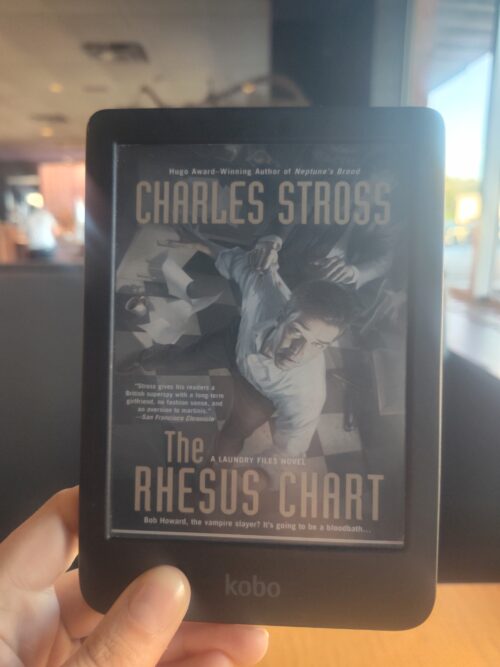
 “Don’t be silly, Bob, said Mo, everyone knows vampires don’t exist!”
This is the one with vampires in it. And investment bankers. Who are the greater bloodsuckers, you might ask? Trick question, they are one and the same.
Up until this point, a lot of the workplace drama side of The Laundry Files—the parts that aren’t based of spy thrillers—have been focused on the ins and outs of being a system admin for the civil service. A disproportionate amount of people Bob (and by extension, the reader) have been rubbing shoulders with have been computer geeks. So most of our interactions with the world of Lovecraftian horrors have so far been filtered through the lens of the nerds. But what happens when unspeakable horrors start permeating through a workplace stacked with more assertive, type A-personalties?
If there’s one thing The Rhesus Chart does well, it reminds us of how predatory and territorial vampires can be.
This is why I love this series, you can’t assume that Stross will follow the typical tropes just because they are in common circulation. Shiller in The Apocalypse Codex, was a true believer of Jesus Christ in a world that doesn’t revolve around traditional Christianity. I had been expecting false evangelist; a more expected trope. But Shiller’s convictions made everything much more interesting when he tried to call the second coming of …something that was certainly not Christ. Here, in The Rhesus Chart, we are dealing with vampires that don’t revolve around traditional vampire mythology, but rather they are tailored to the world that Stross has created. They may not be very gothic, but they are familiar with how to navigate corporate structures—and they know how to leverage HR to their own ends.
Our first introduction to Laundry-verse blood-suckers comes from a young man who’s actually more on the geeky and less on the ruthless side—probably to ease us in. Young Alex Schwartz is very new to the world of investment banking, and is suffering from a good dose of imposter syndrome as a result. So of course, he’s working late at night trying to belt a high dimensional dataset into submission. The details of exactly what he does is not made clear, but he basically has a seizure at the desk after staring too hard at some fractals on his monitor. This leads to 24 hours of strange symptoms that Alex can’t dismiss offhand—burning your face in the sun so badly you smell pork is not really something you can explain away with even the most rampant and neurotic case of hypochondria. So after a night binging TvTropes (and indulging in a little soft porn), Alex concludes that somehow, due to his exposure to higher level mathematics, he’s now become a vampire.
He then infects his officemates—by showing them his computer monitor and pressing play.
This absolutely looks like an issue for The Laundry to deal with. But it’s not just Mo who is of the opinion that vampires don’t exist; the entire organization seems to be parroting that line. Which, Bob notices, is just odd. And it certainly makes dealing with a nest of fledgling vamps a bit tricky. What’s even more of an issue for Bob is that one of the new vamps is his long time ex-girlfriend Mhari Murphy. Who, back in the Atrocity Archives when she still worked at The Laundry, did not come across as the most even-keeled individual. At all.
But one of the Bob’s flaws that has not really been directly addressed—but has been bubbling away at the surface for a while—is that he is not the most emotionally mature individual. Thanks to Bob’s viewpoint, we were given a pretty unflattering initial picture of Mhari, which was apparently not reflective of reality. I still don’t think of her as the nicest or most compassionate person, but Bob really did underestimate how smart she was—to him, she was his wacko ex-girlfriend. He seemed to miss that she was a lot smarter than he gave her credit for. And a lot more socially aware. But to be fair to Bob, it seems the Laundry also horribly underestimated her, letting her go with just a simple confidentiality geas in place to stop her blabbing. Big mistake. Huge.
So Bob now has to deal with his ex-girlfried (and new baby banking vampire) floating around work. Which is certainly not helping the situation with Mo back home. Mo is still working as an Epistemological Warfare Specialist and is dealing with the stress of wielding an Erich Zahn original. On top of that, she is quite pissed at Bob for dragging her normie friend Reverend Pete into the Shiller case back in the The Apocalypse Codex, which means the The Laundry has their hooks in him. And because she’s older than Bob, Mo is having a very hard time dealing with the fact that in the current apocalyptic environment, they are probably never having children. A cat won’t cut it. Bob is aware his wife is upset, but he hasn’t really grasped how bad it is. But because of the incoming clusterfuck at work (KGB.2.YA and all)—he hasn’t got the mental energy to really deal with it head on.
The Rhesus Chart is a bit like The Fuller Memorandum in a way; you wouldn’t necessarily expect the stories based around the London Office to be the most harrowing, but that’s the case here once again. It just goes to show that the scariest threats to the organization are the ones that come from the inside. I love this book, but even though it starts very funny, it’s one of the sadder and more rougher entries in the series.
Sad, rough and peak Laundry Files.
