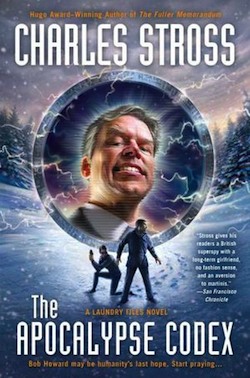
Still making my way through the re-read of the Laundry Files novels and I’ve hit on one of my favorites. The Apocalypse Codex is set nearly a year ofter the events of The Fuller Memorandum, and poor Bob is still sort of in recovery. It’s not just the whole business of receiving a bit of a soul-shellacking from the Black Pharaoh, which seems obvious from the last book. But it’s also the absolute shock he received from work, who have made their intentions to compress him into something more managerial-shaped rather clear. Bob’s had his fair share of bad managers—and he’s seen what happens to them when they step out of line.
While The Laundry is ostensibly a British institution, as the previous books have shown us, the threat of Lovecraftian horrors does not always recognize international boarders. So once again, Bob finds himself handling a threat that has its origins Stateside. Assigned to External Assets, Bob finds himself working alongside two freelance agents in order to investigate the American televangelist, Raymond Schiller. Apparently, the British PM has gotten a bit chummy with the smarmy Texan, who has managed to weasel his way into some government hosted prayer breakfasts. And The Laundry is not ok with that.
While the character archetype of the “evil televangelist” is an easy one to lampoon, Stross does not give us a typical money-grubber that’s out for power. The reason Schiller makes for such a satisfying antagonist in The Apocalypse Codex—probably the best one in the series to date—is that the man is a true believer. He genuinely thinks he and his church are ushering in the return of Jesus Christ and the salvation of seven billion souls. And the end of the world as we know it. And he and his flock thinks that’s fine.
According to Mo’s friend, Reverend Pete, who Bob may have roped in by accident: “I’d call them dangerously loopy heretics who are well down the slippery slope to hell, Bob. A hell of their own creation,” Just because something says that it’s from Christ doesn’t mean it is. Although, there must have been some severe mental gymnastics involved in order to incorporate the isopod parasites into their belief framework.
I don’t think they really lend themselves well to Nicene Christianity.
Regarding the two freelance agents, Persephone Hazard and her right hand Johnny McTavish, they are a delight to read about. I’ll confess, when I first read this book, I really didn’t click that the two of them were written in part as a homage to Modesty Blaise. Hazard (Who I’m choosing to assume actually goes by a more innocuous name and Bob’s just being inventive), is a witch of vaguely continental European extraction while its her beefy right hand man, Johnny McTavish, who grew up in Scotland under the thumb of a church with a somewhat disturbing doctrine who ends up having greater insight into Schiller’s Golden Fleece Ministry than perhaps anyone else from the UK.
I think the reason The Apocalypse Codex is one of my favorite entries in the series is that Stross hits a better balance between satire and the serious in this book compared to the previous three. There is also a lot less exposition; the writing seems to assume you have some familiarity with the series beforehand and as the technobabble is laid on a little less thickly as a result (Although, I note that Case Nightmare Green was perhaps over explained a little too often) The expansion from just Bob’s perspective is also well handled here as well; he is still very much a civil servant and not an action hero. But it’s also here that, with the power of hindsight, you can start to see how Bob as a protagonist has its limits. And that’s something that is tackled in later books of the series.
The Apocalypse Codex really is an incredibly good time, especially when the ‘revelations’ start rolling in. Highly recommended.
