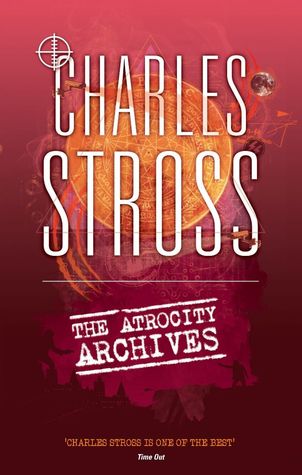
 Charlie Stross finished up The Laundry Files series earlier this year, so I decided I should do a bit of a re-read. It’s been at least 15 years since I’ve read some of these, so I thought a little brush up couldn’t hurt.
But I have to mention something weird about my friends first; when I did a re-read of the Obernewtyn series a while back, I mentioned that I started reading them based off a friend’s recommendation. And this friend didn’t do me the grace of recommending the first book, but rather one in the middle. It’s was only when I was collecting up my copies of The Laundry Files books that I remembered that the same thing happened here too; here you are, you should try this one out. Nope, won’t say anything about this being the third book in the series, oh no.
Thanks guys.
As I mentioned in my review of A Conventional Boy, The Laundry Files novels are based of the premise that what we know as ‘magic’ is actually a branch of advanced applied mathematics. And the worst kinds of magic are tied to advances in computer science. The more powerful computing gets, the greater likelihood that beings from the Cthulhu mythos might break their way into our reality and that’s buh-bye to the world as we know it. The Turing-Lovecraft Theorem, in particular, has the potential to rip holes in your spacetime continuum. This means though that the world’s greatest threats—and our potential saviors—are the denizens of your local CompSci department.
The Laundry is the paranormal/supernatural branch of the British Intelligence Services, and at the start of The Atrocity Archives, our main protagonist, Bob Howard* is less a Fox Mulder type and more of a civil servant. Bob got himself forcibly recruited to the organization after he learnt a little too much for his own good, and has been working as both a system admin and an applied computational demonologist since. It’s not exactly sexy or exciting stuff, and Bob seems pretty over it, which is why he’s eager to move into field work. And after he saves some of his his colleges lives in a training session gone wrong, he gets his chance.
For his first major assignment after the training incident, The Laundry sends him to California to make contact with an expatriate academic who’s been having a hard time making their way back to the UK; there’s been a snafu in occult intelligence relations and the Americans don’t want to let this particular researcher grab an exit visa and go. But it turns out that it’s not just the US spooks in the Black Chamber that have their eye on Dr. O’Brien; the Yanks are concerned that research the professor is sitting on might fall into the hands of the Iraqis or other bad actors from the Middle East. It turns out they should have been more worried about the not so neo-Nazis…
And this is where the plot really gets going. It’s been years since I’ve picked up The Atrocity Archives, and I had forgotten how episodic—or really disjointed—it is to begin with. It wasn’t until about a third of a way through that I started to get some idea of where the plot was going, and it’s not really until I hit the latter half that there’s much action. But when that action really picks up? It shines. This is where the reminds you that is not just using H. P. Lovecraft as a bit of window dressing for some Office-style humor. These horrors are a real threat. You should not try to summon something you cannot control. The stars are not right. The special ops teams are not playing around.
It’s clear form the Atrocity Archives that Stross is a massive geek; he works in a lot of historical and computer programing references here that I think I understand a bit better now that I did a decade and a half ago. But sometimes this technobabble is laid on a bit thick. I think it’s a mixture of both these infodumps and the more disconnected start that makes this novel feel far less polished than many of the later installments. (Particularly notable to me, as, again, I read the later books first.) There’s a fairly extensive afterword though that covers this, and various kinds of cold-ward geekery, if you’re really curious as what inspired Stross—it’s worth a read.
What is amusing about reading this book again after about a decade and a half is how much of a product of its time it is. Bob’s IT babble is very early 2000’s. So is the Black Chamber’s concerns about Yusuf Qaradawi adding summoning a Lesser Shoggoth to his rap sheet. It certainly predates large scale bitcoin mining. I’m not sure how these books would have worked if Stross had started writing them even a decade later than he had,
My copy of the book came with a short novella at the end: The Concrete Jungle. It’s not as dark as the Atrocity Archives , but it does involve poor Bob having to go count concrete cows at 4am in the morning in the name of national security. It’s oddly amusing, and I think it does a good job of showing just how threating Bob’s higher-ups can be when indulging in a bureaucratic war, but it’s perhaps constrained by the fact that Stross has tried to stuff five pounds of ideas into a one pound suit. Still very entertaining.
