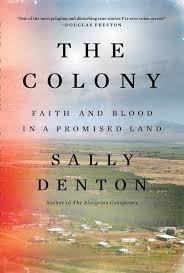
 I have the Harris County Public Library to thank for this recommendation.
Before jumping into The Colony, I have to confess, I wasn’t really aware that the Mormon Church had much of a significant presence in Mexico. But it turns out there a number of prominent fundamentalist Mormon families have been established there since the US outlawed polygamy in the 1880’s.
The book opens with the 2019 murders of three women and six of their children as they drove through Northern Mexico. While initial reports assumed their vehicles were tragically caught in the crossfire of two cartels, the victims all belonged to a fundamentalist, polygamous Mormon splinter group—or extendeded family— known as the LeBaron clan. The more you scratch below the surface though, it becomes more likely that the LeBaron convoy was likely the intended target all along—even if the exact why though remains elusive.
I did initially think that Denton was going to spend most of the book directly focusing on the 2019 massacre—this is very much not the case. Instead, she uses the tragedy as an entry point to explore the wild history of Colonia LeBaron—which she refers to as the ‘power center of Mexico’s fundamentalist Mormons.’ Denton actually has a personal stake in this history, as several of her own distant relatives were part of that initial Mormon diaspora. Through their stories, she lays out a world where the large, complex mormon families bred massive dramas; but on a genuinely shocking scale. For instance, I had no prior knowledge of the Mountain Meadows Massacre, or how that event shaped the fundamentalist belief in ‘blood atonement’—the radical doctrine that certain sins cannot be redeemed by Jesus, instead requiring the sinner’s own blood to be shed.
Now the practice of spilling a sinner’s blood whenever you see fit is less likely to take off under the umbrella of the mainstream church. Or under strong state governance. As the Mormons in Utah sought statehood, the mainstream LDS Church abandoned plural marriage, disavowed blood atonement, and integrated themselves into the U.S. legal system. But the less mainstream splinter groups were having none of it; especially regarding plural marriage. The Mormon groups that fled to Chihuahua had every intention of remaining a law unto themselves.
Of course, this self-governance went about as well as you would expect. One off the more standout figures mentioned in the book is the polygamist leader Ervil LeBaron, whose life sounds like that of a damned Batman villain. The “Mormon Manson” took on over a dozen wives, fathered around fifty children and terrorized both his family and rival polygamist leaders; committing at least 33 murders, although that number may be higher.* And because the their legal businesses were not profitable enough to finance all the targeted killings being carried out on Ervil’s behalf, the Mormon colonies in Chihuahua started to indulge in more questionable activities to get the funds they needed. This lead to the sect leaders building closer relationships with the Mexican underworld, all while their families became more and more desensitized to murder.
So I was not surprised to read that after Ervil’s passing, they started clashing more and more with the locals. The Mormons that had initially moved into Northern Mexico in the late 19th century had been agriculturalists at heart. The LeBarons in particular became incredibly wealthy after establishing massive, industrialized pecan orchards. Pecans, if you’re not aware, need a lot of water. The LeBarons have been accused of illegally monopolizing water rights by the local communities via the digging of unauthorized deep-water wells. These resource wars, combined with the family’s heavily armed self-defense militias and questionable cross-boarder activities, put them within the sights of the cartels. Which then leads to the question: was Colonia LeBaron itself becoming a cartel? Were the 2019 killings a consequence of the LeBarons enroaching on cartel business? Or was it a consequence of the water wars? Surely, someone had not attempted to revive another Ervil-style blood feud? Neither the LeBaron family nor law enforcement in either the US or Mexico believe the case has been fully resolved. And neither does the author.
But we’re not done yet: Colonia LeBaron also had some close ties to the NXIVM sex cult, would you believe. Keith Raniere was apparently fascinated with the LeBarons’ polygamous lifestyle. Although they seem to have distanced themselves pretty rapidly once he got sentenced.
The whole story is fascinating, and I have to say the book is well researched—but they were just some sections, especially regarding the more modern interactions between the Mormons and the state, that I would’ve appreciated more detail on. The non-linear timeline was not always easy to follow either, and the final section of the book seemed a little disjointed. But for someone who didn’t have a lot of familiarity with Mormon history going in, it was eye-opening regardless
*Family and rival polygamist leaders? Often one and the same, to a degree.
