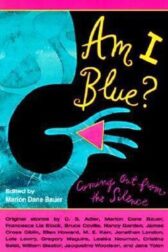
 I picked up Am I Blue?, an anthology of “gay and lesbian” stories for young adults right around when it was published in 1994. I was in middle school, which I had entered with a new haircut that earned me a lot of accusations from more ignorant classmates. But I think this was just a coincidence; I don’t remember questioning my sexuality or gender despite those comments. I expect I either picked it up out of curiosity about the gay community, or that my mom suggested it (either just because or because she was wondering about her own wallflower of a kid). I liked it a lot, or it made an impression on me, at least, because I remember it all these years later as a book that helped grow my empathy for the queer community. I thought it would be fun to revisit it as an adult, and a librarian who specializes in youth services at that.
The collection includes sixteen stories by authors of young adult and children’s books. It includes lots of heavy hitters, both from the queer and straight communities: edited by Marion Dane Bauer, with contributions from Bruce Coville, Francesca Lia Block, Lois Lowry, Gregory Maguire, Jacqueline Woodson, Jane Yolen, Nancy Garden, Lesléa Newman, and William Sleator, among others. Most of these authors besides Coville and Lowry I may have been reading for the first time. Now they are all household names to me, and besides Coville’s opening story (that the anthology is named after), I didn’t remember their roles in it, so that was a pleasant surprise.
The collection is an enjoyable read. It certainly speaks to its time – many stories highlighting concerns around AIDS and people’s misconceptions of it, a fair amount of stories written from the POV of straight characters with queer folks in their families, some protagonists simply questioning – but it also featured stories of some coming out and some having been out for some time. All of the stories are about high school to early college aged teens. None are about gender diverse or trans individuals, and not much mention of bisexuality, which is unsurprising considering its era – it was fairly revolutionary just encompassing gay and lesbian subjects.
The introduction by Bauer is so interesting to revisit, because so much has changed AND so much remains the same. The biggest surprise was seeing her acknowledge that there was debate at the time about straight writers like Coville or Lowry or similar, being allowed to write queer stories. We didn’t have “We Need Diverse Books” or the term “own voices” at the time, but apparently it was a hot topic even when I was a kid reading kidlit. Bauer essentially came out of the closet by publishing this collection, well into her award-winning career as a children’s author. She expressed hopes that the collection would open the door to more, and I think in some ways it did – the amount of LGBTQ literature for youth is certainly unprecedented, but the response to it shows the discouraging lack of momentum Bauer, her queer co-authors, and her queer readers have gained in terms of representation and acceptance of representation in children’s books.
The only story that stayed with me from my original read was the title one – I’m not sure why that one stuck out so much. It’s the first one in the collection, and I was a big Coville fan at the time. It also has a fairy tale theme – it’s about a boy questioning his sexuality who is visited by his “fairy godfather.” But I also had to wonder if I read past that first story or not, as I didn’t have a lot of familiar feeling for any others. Embarrassing for me – though even so, the book did the job in making me an empathetic person.
In my reread, my other favorites in the collection were: M.E. Kerr’s “We Might As Well Be Strangers” and Lesléa Newman’s “Supper,” both about the crossover between being a Jewish teen and a gay one and the intergenerational conflicts that come with it; Nancy Gardener’s “Parents Night,” about a girl coming out to her family before they find out she’s running the Gay-Straight-Bisexual Alliance table at a school social event; Lois Lowry’s “Holding,” about a boy carrying the death of his father’s partner, and navigating whether to out his own father or not to his friends; and William Sleator’s “In the Tunnels,” which imagines a closeted relationship between two Vietnamese young men in the Cu Chi tunnels of the Vietnam War.
I’m glad I revisted the book, and I’m glad queer kids have a lot more to read than they did in the 90s, and I’m sad that their right to read these books is still a “debate.”
