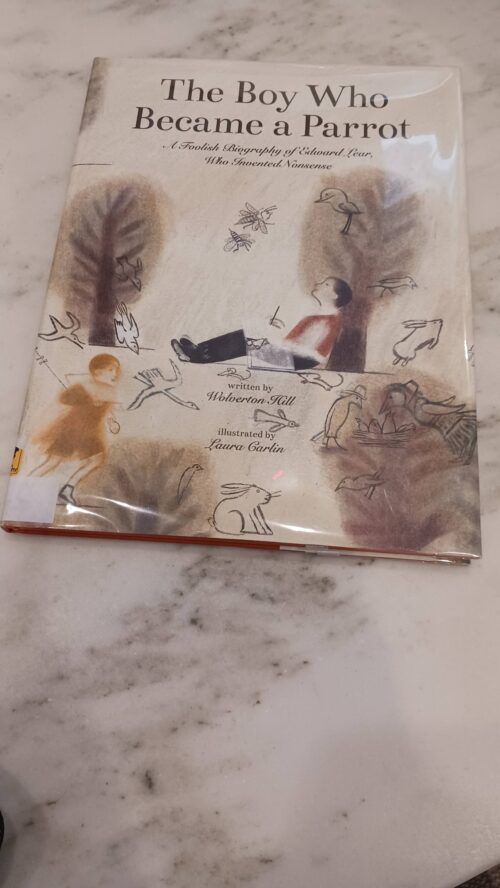
 I kept seeing the title The Boy Who Became a Parrot: A Foolish Biography of Edward Lear Who Invented Nonsense by Wolverton Hill and illustrator Laura Carlin on multiple promotions, lists and emails. I was starting to think I did not want to read it as I have a thing about not reading something that is too popular. This is because I figure, a popular book will sell, be given love. The not so popular book needs someone to find it, to give it the love and attention all books should be given, or at least given the opportunity. But if I have learned anything in my decades of reading, it is to always try to read something, even if you are not completely sure if it is for you or not, as you never know what you might find.
The book talks about a person who went from humble beginnings to a nonsense genius. In many ways the book follows its own nonsensical scheme to tell the life of Edward Lear. It is not a pure biography, but it offers a unique look into the man. Before the actual biographical section, we start with the Owl and the Pussy Cat poem. I knew of it, but had not realized how much there was to it. This and other facts come to life in a longer than traditional picture book.
Even the images are nonsensical. They have a rhyme and reason, but sometimes are mystical and dreamlike. The quality of them feels like cotton candy that has been slightly squished and it will melt if you hold it too much longer. The details are busy but also are floating elements of watercolors almost running off the page. The cover gives you a good idea of what to expect, but there is more than what is shown. And part of the more is that you probably know Lear as the author, but not the natural painter, or the friend, or the man who told silly tales to the best audience he could imagine, children. This is all included on the pages along with what you might know from popular culture.
Perhaps my favorite part is how the title came about. This is due to nature paintings he did of parrots and other animals in various zoo collections. And this is because zoos were not like they are today, the specimens were not alive and this shaped how Lear would view life. I did a quick Google search and some information from the book and online did differ, but I still felt it was a good way to introduce. Factual information is included on the page and in various afterwards as well.
