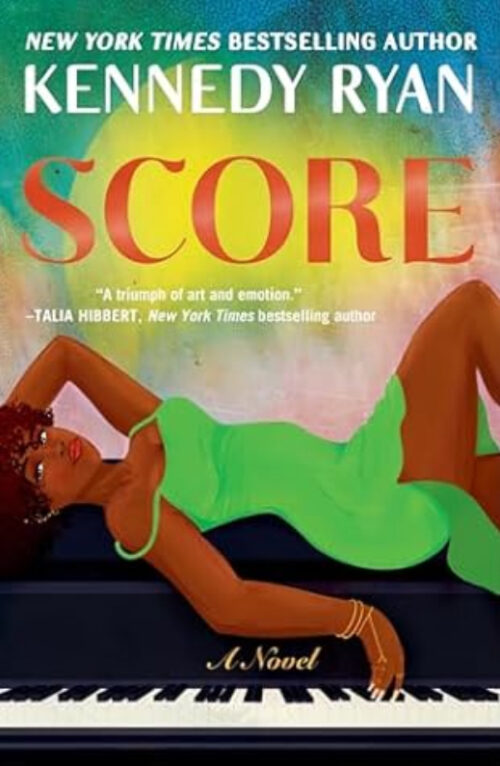
Kennedy Ryan mentioned in her acknowledgments that she considers this series to be “an entire series that focused on the Harlem Renaissance, or that set women fighting for their significance and their own wellness at the center,” and Score follows in Reel’s footsteps, switching from physical health (lupus) to mental health through a FMC with bipolar disorder. Overall, I enjoyed it and thought it was very well developed but it’s heavy. This m is not the novel to pick up if in the mood for a light, breezy or frothy romance. But, it is a romance so it does all pay off in the end, there are just some very hard steps along the way.
We met Monk and Verity in Reel and knew there was some history there. This is one of those romance novels that partially takes place at the same time as the previous one in the series but reveals all kinds of secrets and parallels lives the reader didn’t see (Ryan confirmed at the end of this novel there is one more planned for this trilogy). The novel begins when Verity has her meeting with Canon and Evan, and gets hired to be the writer for his Harlem Renaissance movie. She also finds out that her ex from college has agreed to do the score.
I was surprised by the structure of this novel because I expected this to be one of those second chance romances that flashes between the past and the present but instead Ryan takes the novel back to the beginning and gives the reader the whole story. At first, I wasn’t entirely sure I liked this approach but once we get further into the relationship, it makes complete sense. The novel doesn’t rely on holding the reader’s interest by slowly revealing the past – it shows how devastating the break was.
Verity has always been skeptical of all-consuming love because it destroyed her parents while Monk idolized his parents’ marriage, only for his pastor father to cheat. As a result, Monk is strongly opposed to infidelity. Right when I was finding myself wondering if it would have been better as alternating timelines, Ryan starts peppering in the clues that Verity is at the beginning of her first manic episode, quickly becoming a set of chapters where it’s obviously all going to fall apart spectacularly but you can’t look away.
Over a decade later, Monk is still hurt by her inexplicable actions, and while Verity could certainly explain why it went down the way it did, there are a few things holding her back. Not only does she not want to reveal her diagnosis beyond a small circle, but what if Monk forgave her? While Verity has built a life she enjoys, she also knows that episodes can happen and has seen first hand how it impacts family and friends. Not only with her parents and her father’s undiagnosed struggles, but through her friends she has met in treatment. While it’s possible to manage, it doesn’t guarantee there won’t ever be cycles, and even if the person you normally are would never act a certain way that doesn’t negate the harm.
And yet. There is still a spark between Monk and Verity so despite their reservations, they fall into a casual, no strings attached situationship. The present day time line navigates questions of what can be forgiven, how to open up and be vulnerable, how to believe you deserve something, and how to live with a life-long disorder and still pursue your career and dreams.
Overall, I enjoyed this one even though the college story started as a bit of insta-lust. It’s kind of funny because I quite liked Reel but thought the ending dragged out a bit and here I thought the beginning dragged out and enjoyed the wrap up. There were a few moments where I wondered if the novel slightly romanticized bipolar disorder (Verity saying that her best work had all been done during the beginnings of a manic phase) but Ryan balances that with how well she shows and portrays the negative impacts.
