
Or as I’d call it, “Bartleby the Scrivener, only with murder”.
Years ago, I read Albert Camus’ The Plague (frighteningly enough, during Covid, which is a perfect time to read a book about the mass deaths and utter hopelessness an epidemic can cause) and had always been curious about reading this. Now that I have, I have to say I preferred The Plague, mostly because all I can muster up as an opinion on The Stranger is that I read it and didn’t hate it.
(I read Matthew Ward’s English translation; maybe if I knew enough French to read it in the original language, I might get something else out of it.)
My mood at the end of reading this:
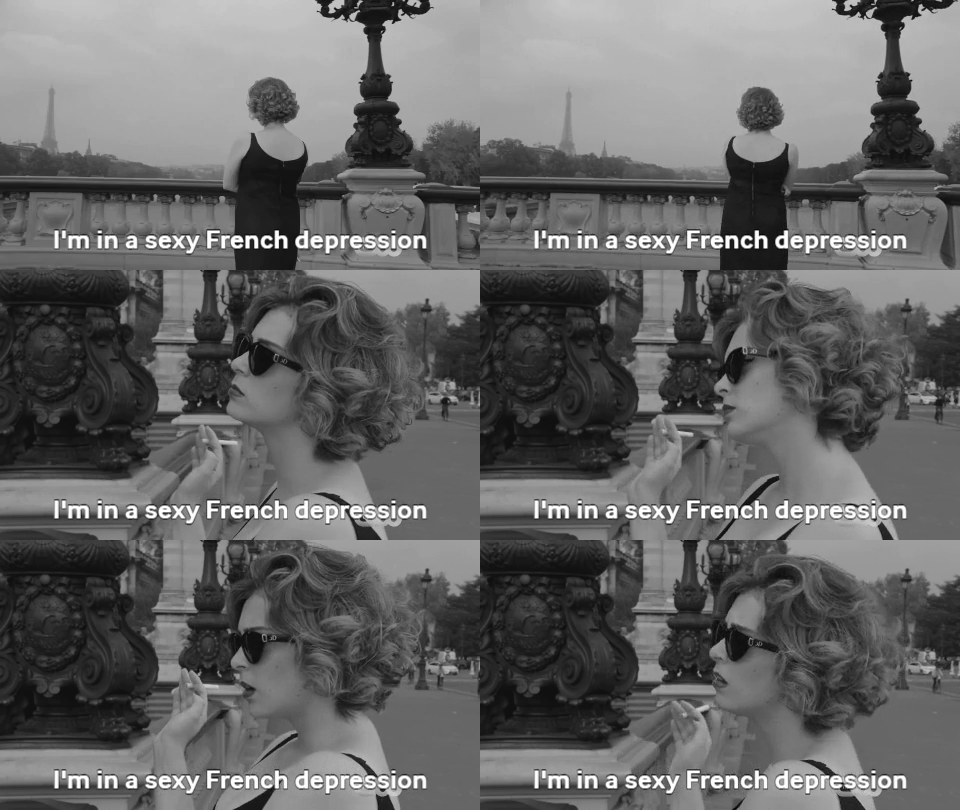
The Stranger is the story of Monsieur Meursault, who in the weeks following his mother’s death, winds up caught up in a slice of life that ends with a murder on a sunny Algerian beach. Or maybe it’s about a sociopath. Or maybe it’s about how exacting a revenge society can take upon anyone who does not subscribe to society’s view on the world. Or how the legal system will twist itself into knots to penalize people while patting themselves on the back for “trying to help”. Or it’s about a “pure” man who doesn’t see the need to indulge in societally pretty lies. Or it’s about a man who is so apathetic to life that he lacks all emotion until the very end. Who knows? Camus leaves you to ponder out exactly drove the events to the conclusion he sets forth; this is a novella that truly earns its categorization as a “philosophical/existential work”. People appear at random, plot points are introduced only to peter out; it’s all very slice of life. Case in point: Meursault observes a woman with extremely strange eating habits in a cafe; she later appears at his trial, along with a reporter who intently stares at Mersault the entire trial (we never understand why.) Or the neighbor whose dog disappears one night; this plot point is never resolved, and he is never mentioned again after his original cameo. Mersault is a man who put his mother in a nursing home because “they ran out of things to say to each other”, and whose response to a marriage proposal is “if you want, I guess yes. Or maybe no” and “Yeah, if another woman proposed to me I’d have about the same reaction.” (Ladies, why wasn’t this man already snatched up?) What is never answered is the question I (and the magistrate) had: if it was all an accident, why the additional four bullets?
The ending was a bit of a shock, mostly because it’s one thing to remember that 1971 was the last year the guillotine was used in France for public executions, and another thing to read its use in a book set in the 1940s, and not by the Nazis. I factually knew it to be true, but still.
I would recommend it as a book everyone should probably read at least once in their life. At 136 pages it’s an afternoon’s worth of a read, and it will give you something to muse over for another day or two.
