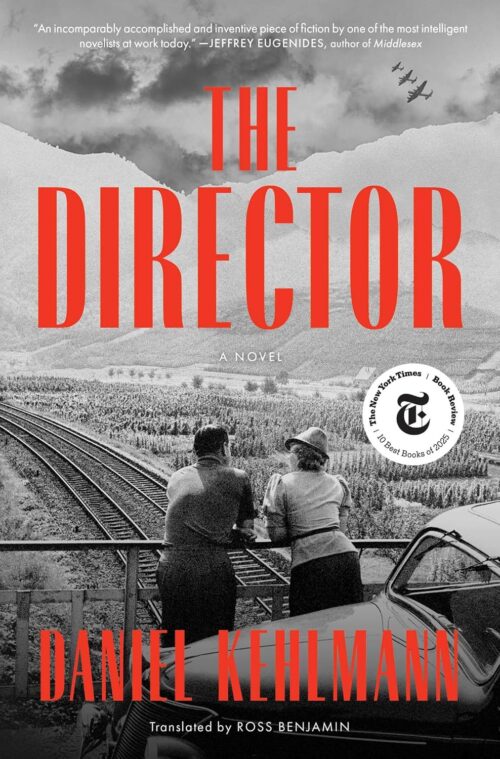
Daniel Kehlmann’s The Director is a highly fictionalized account of the Austrian filmmaker G.W. Pabst, a cinematic innovator who made incredible movies in Germany during the Weimar Republic, struck out in Hollywood, and found himself trapped in Germany at the outbreak of World War II. Pabst was coerced into making movies under the Nazi regime, trying to maintain his artistry and avoid compromising his humanity as much as possible.
Kehlmann takes a panoramic approach to telling his version of Pabst’s story. In addition to chapters from the director’s point of view, Kehlmann also gives us the perspectives of many other characters, including Pabst’s wife Trude, his son Jakob (a complete invention by Kehlmann), his assistant director, and a certain British author living in Germany as a privileged prisoner of the Third Reich who remains nameless in the narrative but is obviously P.G. Wodehouse. These other perspectives are often quite removed from Pabst’s filmmaking world, but still add considerably to the story’s effect. A chapter set at a book club Trude begrudgingly attends is unbelievably compelling, brilliantly depicting the power of groupthink and the silencing of dissent. Jakob’s tragic progression from sweet-natured artistic child to committed Hitler Youth participant, depicted through his terrifying schoolyard antics, emphasizes the cost of Pabst’s self-preservation.
The novel builds to an incredible crescendo as Pabst works on what would turn out to be his final film of the war period, desperately trying to apply all of his skill to turn a terrible novel into a great movie, convinced (in Kehlmann’s version of events) that if he can produce a true masterpiece it will give meaning to what he has done. Kehlmann is almost totally inventing the details here, but his account is so spellbinding and powerful that hardly anyone could mind. Seeing Pabst practically abandon reason as well as morality in order to finish the movie is both thrilling to read and terrifying in its implications.
The Director is a remarkable look at life under a fascist government: the choices it forces onto people, and the reverberating consequences of compromise.
