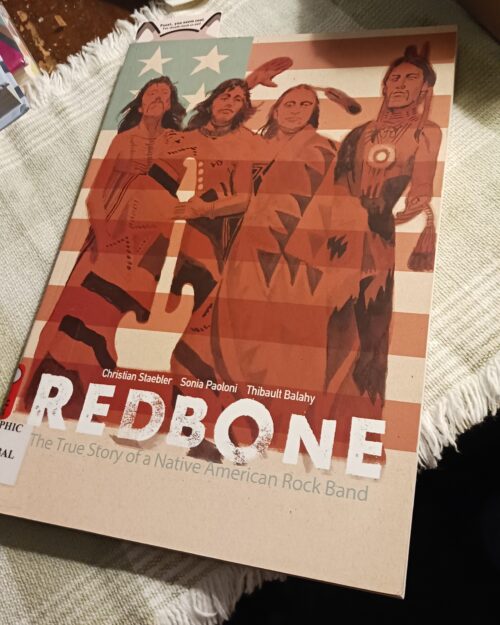
 Several weeks ago I was looking for books in the young adult graphic novel section of my local library. I was in a mood that told me to just grab a few. I know when I’m in that kind of mood, I can find something amazing or something less than ideal (afterall there is a reason it was on the shelf and not checked out). One of those was Redbone: The True Story of a Native American Rock Band by Christian Staebler, Sonia Paoloni, and illustrator Thibault Balahy. I had seen it on lists, promoted, on the shelf of the library. It was interesting to look at (the cover had an odd 1970s vibe, with several Native people standing colored in an off rusty-clay color) but it never “grabbed” my attention completely. But today I was in that mood.
Now, I had only ever seen the part of the title that said Redbone. It sounded familiar, but wasn’t ringing any bells. Looking into it, I assumed history was going to be its theme. Yet, something was niggling in the back of my mind. I couldn’t get it to solidly form, but I felt that I knew that name and it wasn’t Old West-Native History. And yes, it was about history, but not the old west, nor was it modern and Native peoples reclaiming their culture. In a way it was combining the two while staying solid in the 20th century.
Redbone was a band. A band of native men who had to hide that fact. They had to assume a Hispanic background (okay, that’s interesting, being Mexican or other Hispanic background was more acceptable than being Native). Unfortunately, while the idea is fabulous (learning about music of the 1970s and the influence this band had) the execution fell a bit flat. First, the narrator is a band member. They are talking about the past, but it is “today.” I was never really sure what was completely going on. Then there is the color scheme of the cover continuing to the inside which made things off center. The panels did not always have borders. Sometimes the “next scene” was below the “first panel” and sometimes to the right, then traditional border panels would happen. Also, the text was too small and could blend into the images which were not fully fleshed out. And the narrator/story assumed you knew who Redbone was and the people involved, the historical settings, and music in general. In the first few chapters I knew of The Doors, Jimi Hendrix and a few other names, but never was totally understanding why, and yet at times I was, “Now that’s cool.” Then there are their political influences. They were not just a band, but a band with purpose. One chapter is about AIM and there is a section on Wounded Knee (I’m assuming not the late 1800’s one), and these could have proven educational, but I just can’t get there to read.
In the end, I did not finish it. I would like to, but it is an odd book that needs a mindset that is willing to take the time to read slowly, to be able to absorb all the people, places and ideas at a somewhat rapid pace. Someone who is more willing to read between the lines that are not there for the images. Skimming ahead, I noted several extras that seem like they will be interesting if you like music, Redbone, or Native history. So I am giving it a 4, but it is more of a 3.5 for me. However, the right reader will give it a 10 and I’m glad I tried reading. Maybe someday I’ll try again.
