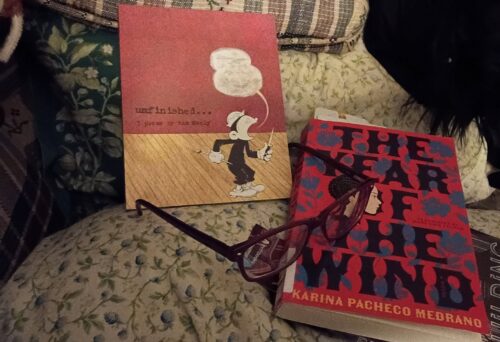
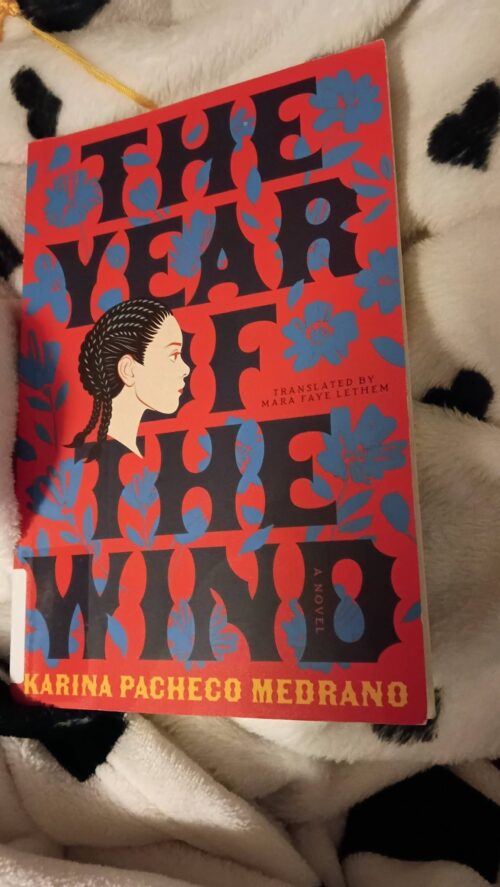
 Not only have I given The Year of the Wind by Karina Pacheco Medrano the ol’ “college try,” I’ve given it a Masters and almost a Doctoral try. Needless to say, I really did try to read this book, but it is (in the spirit of one of the CBR Diversion – Describe a Book Badly): about a woman who goes on and on and on and on and on and on and on and on…. About her (most likely) dead cousin who she has an admiration crush on and tosses in the 2020 pandemic in the middle of her talking about the horrors of the 1980s in her home country of Peru from Spain.
Now, I know that sounds callous as the events of the book are horrific. But while I could see the (publisher description) devastating effects of political violence in Peru on three women’s lives coming to life on the page, the way things were presented was difficult to follow at times. At first there was a traditional novel format. Okay, it was slow going for me as it is an adult novel and the writing style not my personal favorite, but when Medrano tossed in this almost prose poetry section from someone (The grandmother of the cousin? The female ancestors talking to the women of now/1980s? Or the actual spirit of the mythical Mama Huaco, whom these women claim descent from; the woman that has given them their strong resolve to not only survive, but to thrive?). I was “Huh? What?” Then we go back to novel format. Our setting is first we are in Spain, then in Peru, back to Spain, Peru…. I did get a rhythm going and I was picking up what they were putting down, but then “Wait a minute! What’s going on?” The times in Spain seem disjointed and off in multiple directions and repeating itself, then we throw in a woman our narrator claims is her cousin, only thirty years too young to actually be her! This is just the first half of things, I never got to the point where the narrator goes back to Peru.
Yet, this seems as if it would have been an amazing, if not difficult, book if I just could find the uninterrupted, quiet time I need to sit and process. To take my time as I learned about our characters and how their coming of age was literally and figuratively violent. Becoming a woman is bloody (menstruation). Trying to grow up without being assaulted is an everyday thing (the cousin carries a switchblade after she is almost gang raped). Trying to teach children in the jungle areas is hard enough without guerilla soldiers coming in raping and killing and kidnapping people to force them into other Marxist soliders. Even the cities have the dangers of protests, police violence, accidents that are not so accidental, and not to mention the being arrested and tortured. All this and more is an open secret as the country is torn about in the political unrest.
I think if Medrano had focused on Peru and left the parts of Spain to a minimum, stopped repeating about the pandemic and why she is in Spain, or that it is “this time around in Spain,” and focused on trying to find her cousin or find out what actually did happen, it would have been better for me as there were just too many parts for me to follow happening all at once.