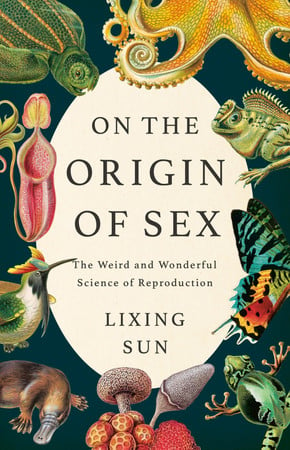
 One of the things I love about studying the biology is that nature loves itself a curveball. You want to categorize everything into a set of nice little boxes?—better guess again. If there is a little crack to be filled; a little niche waiting to be exploited? Evolution will find itself a way.
One of the biggest questions in biology is the evolution of sex—why does it even exist in the first place? To answer this, Lixing Sun asks us to imagine a world without it. That is not too difficult, as asexual reproduction remains highly prevalent. In many ways, that is an advantage, since it allows every single individual to propagate on its own. And we aren’t just talking about simple, single-celled organisms either; parthenogenesis occasionally crops up in vertebrate species as diverse as California condors and Komodo dragons.
So why did we need to turn to sex? One major reason is recombination—the shuffling of genetic material. Genes don’t just exist in the ether; they’re physical entities sitting on your chromosomes. And unless you shuffle and swap things around between your pairs of chromosomes while producing gametes (sperm and eggs, in short—needed, of course, for sexual reproduction), you would never be able to escape the harmful burden of ever-accumulating harmful mutations which are sure to be inherited alongside the genes you need for basic viability—the burden of Muller’s ratchet.
And that’s just the start. Sun himself admits that his book is a ‘whirlwind tour’ and a ‘fast selective ride’ into the nature of sex and its dynamics. It certainly covers a lot of fascinating topics that may be new to a lay audiance, from Red Queen scenarios (evolutionary arms races requiring constant escalation just to maintain the status quo) and the concept of kin selection to the bizarre differences in sex determination across species.
Again, nature abhors the little categorizable boxes we keep on trying to wedge it into. Is sex determined by chromosomes? The size of your gametes? Will you stay the same sex throughout your life? And even if you don’t switch genders, is it possible you’ll switch gender roles? Sex determination, development and behavior in animals is a complex business, and there is a wealth of diversity out there—if you’re willing to look for it.
One of my favorite examples involves certain fungi, who have thrown the whole system out the window. Two sexes? Please. So passé. Split-gill mushrooms have a cornucopia of different mating types. Rather than a clearly defined set of sexes with dissimilar gametes, these mushrooms use a mating system which relies on two separate genetic loci (locations) with multiple different alleles (genetic variants)—and you cannot mate with a match. We are counting combinations in the thousands here, people!
Sun’s writing is very chatty and casual, and his enthusiasm for the subject is very infectious. I feel that sometimes he over-humanizes his non-human subjects in a way that may leave a layperson with the impression they might have agency in a set of biological processes where they do not—but have been guilty of this myself when describing these things so I can’t really criticize too hard here. *
But what is clear from reading On the Origin of Sex is that there are so many ‘known unknowns’ out there with regards to sex and evolution. If there is a rule, nature will bend or break it. And we simply don’t know what new and unpredictable ways it’s going to act next.
For cbr18bingo, this one is Wealth. Why? For the wealth of diversity we see in nature and in sex
And while I’ll come back to check, I think that’s a blackout
