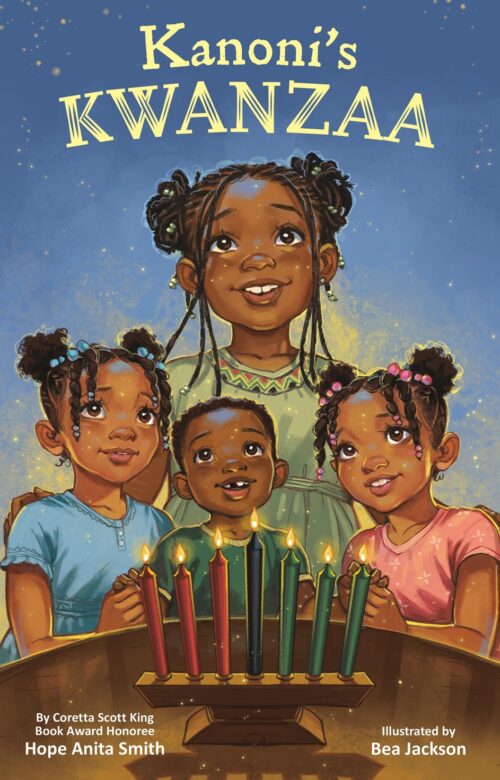
 For the wonderful holidays of the winter season, I try to find at least three or four different types of books. I like to find for Christmas a religious book and a non-religious one (Santa is preferred), a Hanukkah book and “something else.” It’s hard to find Kwanzaa stories that I really “get into” but I think I have found one of my favorites ever.
From now until it goes out of print, I will be recommending Kanoni’s Kwanzaa by Hope Anita Smith and Bea Jackson. This book is a thoughtful read. A young girl, whose name means “little bird” learns about Kwanzaa. She learns that it has seven nights, and the different meanings of each candle. This is their first year to celebrate. But before their celebration can start, they realize their neighbor’s home is on fire. Our young narrator might be little, but she is mighty. And she convinces her parents, though their house is small, it has a big heart (just like we learn she has). We follow what happens during the week the family stays with them, the realistic feelings and events unfolding at a slow but steady pace. And at the end, there is a little surprise about the real meaning of this holiday.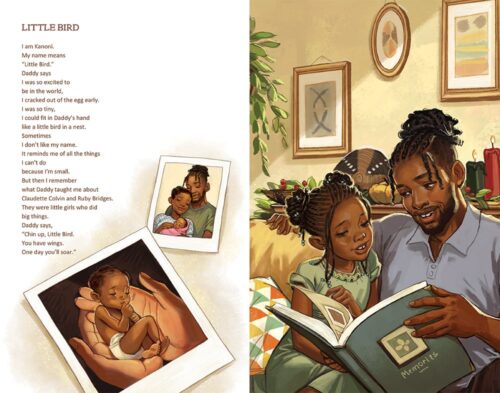
The images are sweet, deeply colored, medium to busy detailed images, yet not crowded. Things flow together, they show you what is happening without being too intense. You never see the fire or the house, but what the neighborhood will eventually do to help out. Several extras are included.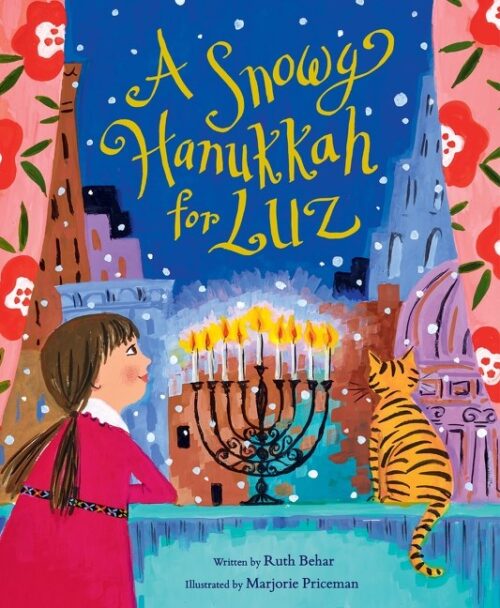
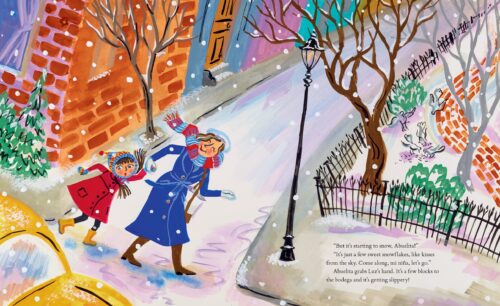
Another small, but mighty girl, is Luz in this year’s Hanukkah recommendation; A Snowy Hanukkah for Luz by Ruth Behar and Marjorie Priceman. Like our other heroine, Luz learns about her family and their holiday by counting the miracles they find. It is more themed and focuses on the holiday, but still flows well and has a fun and sweet ending. One of the pieces I particularly enjoyed is the fact that Luz’s family is Western, mixing Ashkenazi and Sephardic traditions (via the publisher description) with the language of her neighborhood (the man who runs the bodega speaks Spanish, the neighbors are from all walks of life).
Priceman’s illustrations are both very much their style but I also couldn’t place them. Which was something I enjoyed. I liked how you knew who it was, with that familiar cozy look (bright, bold, colorful, details in just the right amounts) and yet, it did not distract so I wasn’t thinking, “Oh that is like this book or that one.” The images support the text and allow for another story as well. And while I have enjoyed Priceman’s other illustrations, I think Luz’s story is my favorite images so far.
Both titles are out, but I read via online reader copies.