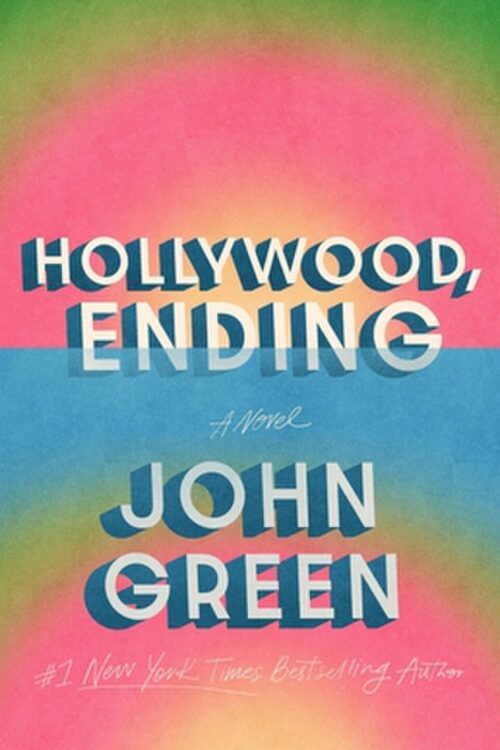
I am too old to have read any of John Green’s previous novels as part of their intended “young adult” audience.” Yet, I have read and enjoyed several of them for what they are. Hollywood, Ending is billed as his first novel for adults, no modifier needed. The plot, however, shows that Green may not have wanted to stray too far from his roots.
The story concerns too actors in their early- to mid-twenties, both cast in an Andy Warhol biopic alongside a much more established movie star. Kai Laramie is a young man just starting out in the business, buoyed along by his immense personal charm. His co-star Juniper Castillo can’t help but be enamored with him. She’s far more established, having spent years as a child star thanks to her pushy stage mother, who passed away while Juniper was on a teen show. Juniper’s traumatic upbringing is public knowledge, but Kai’s past contains a story that he desperately wants to keep out of the press because of how it could overshadow his emerging career.
While they’re filming their biopic, both Kai and Juniper are angling for their next big role. Juniper has her heart set on playing the young queen in a big-budget adaptation of a popular fantasy series. When Kai and Juniper’s on- and off-screen chemistry hits the press, thanks in part to some P.R. trickery, it looks like they might be cast together in the fantasy movie, which is just fine with them.
At times Hollywood, Ending threatens to become a very generic, trite literary effort, with John Green utilizing his experiences being so frequently adapted in order to give readers the sense that he knows how “the industry” really works. Ultimately, though, the seriousness of Kai’s revelation gives the novel new territory to explore. What would it be like if the worst time of your life became public fodder right as you were becoming a major public figure? How much worse could press junkets really get?
Predictably, Kai’s secret becomes an issue between him and Juniper. Opinions will vary, but I thought Green did a good handling this potentially difficult terrain. It would be easy for this to come off as either exploitative or sensationalized, but Green manages to create a conflict that feels earnest and not rooted in one character or the other being an idiot or a jerk.
Hollywood, Ending doesn’t exactly prove that John Green has left young adult fiction behind, but as a start it shows promise.
