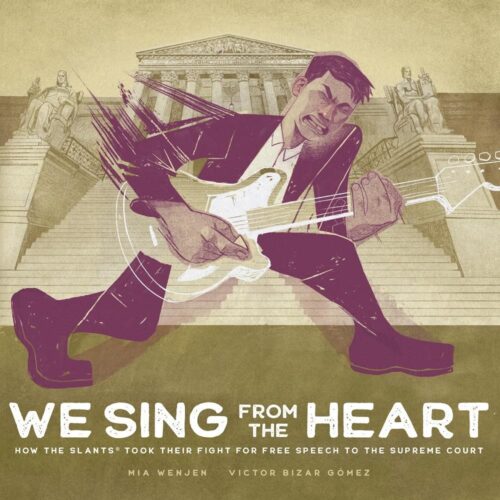
 We Sing From the Heart: How The Slants® Took Their Fight for Free Speech to the Supreme Court by Mia Wenjen, Simon Tam (Foreword), and Victor Bizar Gómez (illustrator).
I had never heard of the band, The Slants. I had never heard of their legal struggles to have the name they want. I was unaware that there was such a thing as “Chinatown Dance Rock.” But there is a band called The Slants. They had an eight year battle to patent their name. And there is “Chinatown Dance Rock” (or their self-described style called that, which blends synth-pop, new wave, and dance-oriented electronic rock).
Read via an online reader, though the book is out, I learned all of this and more. Less focused on the music and more on the legal issues, we follow Simon Tam as he found his voice (throwing the slurs (which are said) back into the faces of his bullies for starters), how he found his music, and how he found a way to take back the racism he and others faced. Things are a bit dense, so it is not an easy read. I am not sure of the final look of things, but I don’t think it would be a usual picture book, and even if it is in the form of a picture book, the content is for older readers.
This is a hard recommendation as, while it is good, there is a limited audience. If you like music, sure you can learn a few things (remember I learned there is a band) and if you like Asian-American history this is good, but neither is fully explored. Even the court and legal parts are not “deep dives.” Overall, it is an introduction that highlights things, gives you a little more, but then allows you to move into the next part. There are extras at the end that give you even more, allowing it to grow with the reader and what interests you.
The cover gives you an idea of what the illustrations look like. They are not necessarily “comfortable” to look at, but I think that is the point. The story is about racism and taking it back, so why should the reader be comfortable? I found this book to be emotional due to my own personal experiences (I have Japanese American family) and how I have a privilege they don’t have. I don’t get “lumped in” with other Caucasians. I don’t have the situation of “What do all Asians have in common? (Answer: Slanted eyes, said with a sigh in the book).” So this is also why it is a hard recommendation as it is not a light, fun story about how a band got “it’s groove” but how they took what others used to harm and used it as a strength.
