 Have you ever gotten the feeling that here, in the time we find ourselves in, that perhaps everything is just a bit to much? Life is an omnishambles and you can’t bare to open the news because you can’t stand to see the news; is anyone going to care about the threats of climate change or emerging pandemics; does anyone really care about the future we are leaving our children? Forget the future, does the government care about children right here, right now? Or is the prevailing attitude ‘fuck them kids’?
In the Anthropocene, can anyone hear you scream?
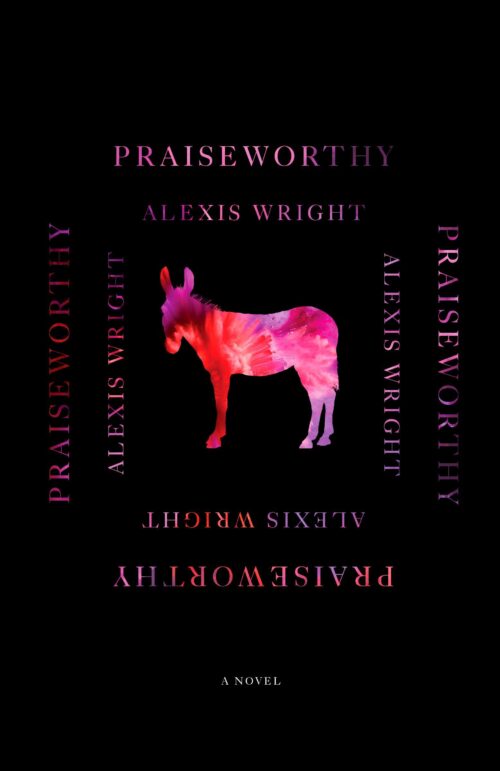
Well, in Praiseworthy, Cause Man Steel is one of the people out there who has had it. He knows what the apocalyptic post-fuel era could bring,* and screw what everyone else thinks, Cause is going to act. In a move that is meant to remove the local economy’s reliance on fossil fuels, grant economic sovereignty for every indigenous man woman and child in his town, show solidarity with the world’s poor, and potentially take advantage of Australia’s feral animal issue, Cause is going to try and set up a donkey-based transport conglomerate—a business for a new world.
Cause is a man with big ideas, as you can clearly see. And his biggest idea involves finding himself a figurehead; it won’t be enough for Cause just to muster the nation’s millions of feral donkeys and hitch them here, there, and everywhere—he needs to find himself a special donkey: a platinum-coloured Jesus donkey that’s 100% more efficient than Qantas and totally global-warming-proof. And once he gets ahold of this mythical beast, everything will fall into place. So Cause packs himself into his ageing Ford Falcon and speeds off into the vastness of Australia. He will rule the place from the colonialists’s waste.
The town of Praiseworthy isn’t exactly on board with Cause’s’ cause, so to speak. Praiseworthy prides itself on being a nice little tidy town, whose two most notable features—normally—are the ramshackle downtown churches and the cemetery. But times are not normal and Praiseworthy is being menaced by a yellow haze of dust that has come to blanket the town, and it will not budge. You would think that a town so clearly suffering from the ills of the Anthropocene would be a little more open to doing something about climate change, but no dice. The townsfolk certainly have no patience for the likes of Cause Man Steel:
The vision man was too lackadaisical with his slow symphonic breathing of red dust in and out of his lungs from out there on the flat, the void which he referred to as being the eyesore of the world. This big prick of a fellow, evil through to the core, who was called Planet, or Widespread, or by his real name sometimes, which was Cause Man Steel. Who remembered his real name anyhow? It was not worth remembering. No one wanted to remember his name. They could not be bothered remembering the fellow’s name for the way he was buggering up their part of the planet with mad ideas for his global warming business that had nothing to do with them.
Everyone was an angel in Praiseworthy so they say, because if you weren’t, it meant your life belonged elsewhere. So! It was really vogue to be one of those angels in rotten times, although this fellow Widespread made the whole angle of being an angel ready to assimilate white look ridiculous, by acting like he was the biggest and only real guardian angel in the ancestral law-bound black man’s world.
To be an angel here is to be in the good books of the white Australian government, and no one personifies this more in the town of Praiseworthy than the Major Mayor, Ice Pick, an indigenous albino man who cruises around the town in his hot pink SUV, making mayoral proclamations over loudspeaker and being fawned over by his very own all-female fan club. He thinks Cause (AKA Planet, AKA Widespread) is a piece of shit, but maybe he just can’t handle the fact that there’s another aboriginal man in his small town who can propose ideas as grandiose as his own. One of Icepick’s many grand plans involves soliciting a grant from the Australian Government to build a 30-meter tall scarecrow of himself to scare away the yellow haze that plagues the town—that ought to do it!
But Cause Man Steel is not the only member of the Steel family to have an impact on Praiseworthy. Cause’s wife, Dance Steel, has set up shop in the town’s cemetery and seems more preoccupied with moths than other people. Like most of the inhabitants of Praiseworthy, she is not on board with Cause’s donkey-filled aspirations, and she wishes he’d be more concerned about his kids. Dance has concluded that Australia is not a safe place for herself or her children anymore and, convinced she’s secretly of Sino-Aboriginal heritage, has taken to spamming so many institutions in Beijing about acquiring permanent residency that they’ve started to freak out and accuse her of stalking the Chinese government.
And of Cause and Dance’s children? Aboriginal Sovereignty is seventeen and little Tommyhawk is eight. Aboriginal Sovereignty is a pivotal figure in the town of Praiseworthy—and the novel itself—but serves more as a figurehead than a character. His father named him that because those were the two words he loved to say the most. Admired by the town, even though his parents are despised, Aboriginal Sovereignty has been accused by the government of crimes he did not commit and has walked into the sea as a result. It’s not until the town of Praiseworthy has lost their Aboriginal Sovereignty that they start to think about what that exactly means for them, and whether there is a chance he/it can be recovered. They didn’t know what they truely had until it was gone, and now they’re collectivly going through all the stages of grief.
But if the elder brother is a figurehead, the younger is one of the most complex characters in the book—or the one that stays with you the longest. Tommyhawk may be only eight, but already he has been labeled a Kid Fascist—by his father, no less. Addicted to his various iWhatnot devices, Tommyhawk can be seen as a lesson in not letting your kid have unfettered access to the internet. Sneaking around the town like a ninja, trying to charge his devices at homes that haven’t had their electricity cut off, little Tommy has become convinced that Praiseworthy is full of paedophiles, and that his brother must be one of them. This kid has been keeping himself awake at night masticating on his own thoughts over and over, almost to the point of psychosis: how was he going to escape the threat of these dangerous men? Bugger the other kids—Tommyhawk is only out to save himself.
The answer? He decides he needs to convince the Minister for Aboriginal Affairs to jump in her private jet and fly over from Canberra to adopt him. His hope is that this blond haired, angelic, proclaimed Mother of all Aboriginal Children will surely see how wretched his life is—Dad is chasing donkeys, Mum is off with the moths, brother is one of the paedophiles—and scoop him up to live at Parliament House and let him sit in her swivel chair and access all the internet he wants.
This leads us to a mortifying set of scenes where Aboriginal Sovereignty is walking into the sea while his little brother watches from sidelines, trying his hardest to be gleeful about his suicide. And make no mistake, Tommyhawk is actively trying to convince himself that this event will cut his tether to the town and convince the golden-haired mother-in-Canberra to adopt him. Wright’s depiction of Tommy’s mental processes here is one of the best descriptions I have come across of someone wresting with the cognitive dissonance that comes with standing on the edge of the ‘pilled’** rabbit-hole. Except this little boy’s grey matter is not playing mental ju-jitsu with something spat out from the sovereign citizen sewerage pipe-line; little Tommy is dealing with propaganda fed to him direct from Canberra.
There was no denying the fact that sometimes, Tommyhawk felt obliged to un-suppress some of the weaker arguments that barged through his betwixt and between conscience when it showed up in his brain. He was not inhuman. He just knew how to keep a lid on berserk emotion playing tennis with his soul, bashing the ball at some rare spontaneity of guilt frog-leaping out of its house, to force him to feel obligated, to consider the meaning of family relationships, releasing a fusillade of more and more guilt asking—But isn’t he—I mean—isn’t Aboriginal Sovereignty your brother? Shouldn’t you care about what happens to him? Whack! Whack! Tommyhawk knew that you had to whack that idea out of your brain if you wanted to rule the cruel world.
But is his brother really gone? Maybe Aboriginal Sovereignty just disappeared—for now. Could the townsfolk find him elsewhere? Or is Ice Pick going to hijack the search and start assigning a murderer?
This is where we return to the idea of the omni-catastrophe; while it’s not 100% evident at the start of the novel, it soon becomes clear that Praiseworthy is set during the time period of The Northern Territory National Emergency Response which lasted from 2007 to 2012. “The Intervention”, as it became known, was seen as a truly catastrophic time for remote indigenous communities. While there were many, many criticisms of ‘The Intervention,’ Wright seems to be most heavily making reference to the ugly rhetoric used to implement it and implication that indigenous communities were incapable of responding to their own issues. But time is not 100% concrete here; both Tommyhawk’s case of online brain-rot, Trumpian-inspired boarders and the mentions of pandemics seem to indicate a slightly later time period while many of the ghosts of dead children originate in the long past.
But the problems here of government demonisation and assimilation are long running, so do we really have to assign fixed dates?
That’s not the only quirk with Wright’s writing style; it’s indirect and deliberately meandering. The book is mostly written in the past tense, but Wright will switch to the present when she needs to. It’s also written mostly in the third person, but again, it will switch on whim. Sometimes you can’t tell if Wright is using the generic second person You or if she’s decided that wants to directly address You, the reader. Her prose is brashly, unapologetically Australian, and full of little interjections of Yep! Mate! So What? It’s a book that begs to be spoken out loud and makes me think I should also pick up the audio version.
And it’s not only little Tommyhawk that gets caught in a vortex of his own thoughts, because nearly every character does the same thing; there are no straightforward minds in the town of Praiseworthy. As a result, the narrative does not directly flow, but more twists and turns back on itself, over and over, like particles in caught in a dust storm. Wright’s language also shows incredible flow and it am downright in love with it; usually it was enough to just let it wash over me but then there would be a certain phrase or paragraph or two that would pull me out and make me laugh out loud. There is a reason I am being so liberal quoting the book here.
One of my favourite scenes involves Cause arguing with an aging donkey squashed into the back of his Ford Falcon. He’s trying to convince said donkey that if it wants to stand out as the head of his new, big transport conglomerate, it has to make itself smart and easy to get along with like all the other donkeys. But hey, maybe the donkey wasn’t aware that it’s meant to act in that manner if it’s not been able to watch how other donkey comport themselves in other countries on The Discovery Channel, like Cause obviously did. The donkey, on the other hand, doesn’t care about The Discovery Channel, it just wants to retire! All while the Falcon, with its miraculously rebuild engine, is making its way along a spiritual highway, made up entirely of moths.
Why did the engine need to be rebuilt? It seems to be in tune with the narrative:
The compression in the cylinder head of the vehicle kicked in because it knew it had its part to play in the big vision even if it was only machinery, motivated by Cause’s brain turbocharging and belting around the bush in his head to check with the big checker running the universe into overdrive, about how the eventualities of the future era might pan out.
Then there is also the Canberra Super-cop, Maximum Security Service, who thought he was going to sort out this Aboriginal Sovereignty business by blasting into town in his Avis rental van like it was a viking longship, and instead finds himself having to deal with rebellious babies.
While I delighted in Praiseworthy’s operatics and its distinct prose, I won’t lie; this is not an easy book to read. And at over 600 pages (ebook) it’s quite intimidating. But it’s well worth immersing yourself in, and to me, it’s obvious why Alexis Wright won the 2024 Stella Prize. But even when you are being crushed by everything from all sides, you can still remember what is important. And you cannot kill what is infinitely existing.
For cbr18bingo, this one is You. Why? For when you are addressed directly, because the story is being told to you.
And that gives me both a vertical bingo in the middle and the diagonal top right to bottm left
