
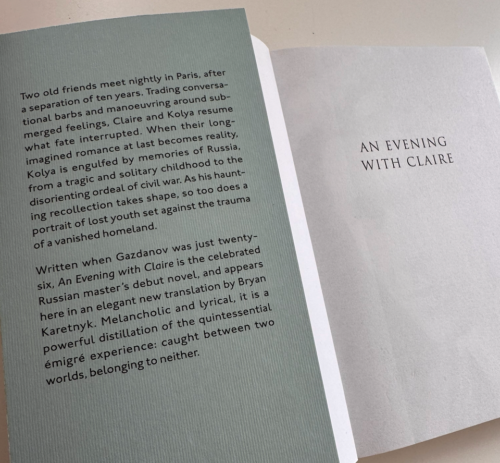
This is a good book, in the sense that it is honest. But don’t be fooled by the cover! It is no delicate romance — and Claire hardly figures. In An Evening with Claire (1929), Gaito Gazdanov drags the reader through the emotional swamp of emigré estrangement, through a barely-disguised “Kolya.” Like Gazdanov, Kolya joins the ill-fated White Army in the 1910s, seemingly on a whim, after a largely apolitical and lonely childhood. Over the course of a few years, he drifts to the edges of the former Russian Empire, and then simply slips away to France. Gazdanov memorably compares this transition the time he killed an ocean bird, and watched it bob on the tide until it was slowly pulled out to sea. This is the way of the book: suffering (partially self-inflicted), and very little struggling.
After sliding out of Russia, Kolya shifts his focus to Claire, an intense childhood crush, who he correctly assumes has returned to her home in Paris. Claire is France, France is Claire, and though she doesn’t really want Kolya, she will allow him to amuse her, at least for an evening. Her meagre scraps of affection are enough bait for Kolya to lie a decade in wait. He has singled her out as an object of intense obsession, while harbouring an isolationist attitude towards almost everyone else around him. Reunited in Paris, he hovers around her like a queue ticket holder waiting for his number to be called, too insecure and needy to actually make a move on this married, wealthy, self-knowing woman who sees right through him.
Reading this book made me wonder if it was really meant to be read — it is intensely personal, and not terribly flattering. Though Kolya seems to recognise and regret his mother’s coldness and sense of superiority, he inflicts it mindlessly on others. He only realises that a childhood companion might have been a friend after happening upon the boy’s gravestone. Aloof Claire is described in far more detail than the interchangeable cast of characters that populate Kolya’s childhood, including fellow soldiers who fought alongside him. One wonders if it is Russia who is callous and lonely, or if Kolya never bothered to form meaningful connections with would-be friends and comrades. He acknowledges that he always intended to leave them behind. Yet, he seems surprised not to be able to feel regret or loss. Much like he is surprised that a dead bird cannot swim to shore.
This book is frequently described as melancholy, but I disagree. Melancholy implies something to mourn; and perhaps an amount of reflection on the loss. Instead, the dominating feeling of this book is emptiness. There is no valiant struggle against the currents of life; only a depressing awareness that some fundamental gravity — the gravity of home, family, or country — is missing. I could only recommend An Evening with Claire to those who have never experienced homesickness. Though, fair warning: getting through each page feels like swimming upriver in the current of Gazdanov’s mind.
cbr18bingo: bird