 CBR18 BINGO: You, a homophone of “U.” Also because I speak and write in English.
Double Bingo! Diagonal: One, Map, You, 26, Or
Four corners and the center: Left, One, Repair, Or, You
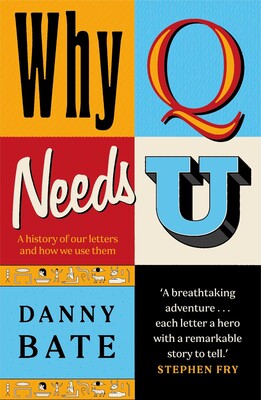
I’m amazed that anyone whose first language is something other than English can ever master writing in this silly language. It’s so full of contradictions and spelling travesties that one has to wonder how we got to this place. Danny Bate has written a highly detailed account of exactly that. In the introduction, he recounts a charming poem on this subject by a Dutch writer named Gerard Nolst Trenité (1870-1946), scathingly titled “The Chaos.” It begins:
Dearest creature in creation
Studying English pronunciation,
I will teach you in my verse
Sounds like corpse, corp, horse and worse.
I will keep you, Susy, busy,
Make your head with heat grow dizzy;
Tear in eye, your dress will tear;
Queer, fair seer, hear my prayer.
Yes, English is enough to make any logical person tear their hair out (how do those words rhyme?). Bate, a linguist, writer, and self-proclaimed nerd, traces the history of our letters and how they were shaped by history and culture. Romans, Greeks, Phoenicians, the Great Vowel Shift, the ongoing controversy between Camp zee and Camp zed, it’s all part of the story.
I’ll be honest. . . I love learning about language and quirky history, but this book was a little too in the weeds for me. The quote on the cover from Stephen Fry calls it “a breathtaking adventure,” but I’m comfortable with the fact that Stephen Fry is much smarter than me and can read this sort of thing for pleasure. I was interested, and yet I found myself glazing over at times. This is probably a book better experienced on audio, as some of the distinctions the author makes between different pronunciations were challenging for me to follow on the page. At the same time, the drawings of early letters have to be seen to be understood, so maybe you need to invest in both the audio book and hard copy to get the full effect.
A common theme in this book is that pronunciations change over time, but it takes much longer for writing to catch up. As Bate writes in his epilogue, “As soon as spelling is set, speech slips through the fingers of writers like the air of which it’s made.” An example of this is the word “knight.” At one time, the k was pronounced (which may explain why the silly French knights in Monty Python and the Holy Grail are so smug). By Shakespeare’s time, it appears that “knight” rhymed with “night.” Yet that “k” remains, forever taunting grade-school spelling-bee participants. Will we ever experience a spelling language reform where the “k” is dropped? Perhaps, but if I were to see the word without the “k” I’d be completely baffled. Spelling and speech have a complicated relationship.
This is a painstakingly researched book and the author clearly loves the topic, so I wish it had felt more “fun” to me. I did learn many interesting tidbits, though. For example:
- An inscription that lists the letters of the alphabet, usually in order (like you see above the blackboards in schoolrooms) is called an abecedary. (This is my favorite fact from the book.)
- The oldest surviving Latin letters to be known to be written by a woman date back to 100 CE and were an invitation to the writer’s birthday party.
- The letter K gets its shape from a depiction of a hand (the prongs of the K originate from fingers).
- In an attempt at English-spelling reform, Benjamin Franklin tried to get rid of letters Q and X (finding them redundant with K and S).
- The word “ostracism” comes from the Greek “ostracon,” which is an archaeological term for a broken piece of pottery. Athenians would use ostraca in official banishments (thus, the punished person was ostracized).
- The Great Vowel Shift, which, as the name suggests, changed the way we pronounce vowels, lasted several hundred years (1400-1700). This might be common knowledge, but for some reason, I thought this had been a speedier process.
If you’re a language nerd like Danny Bate, you should definitely read this book. I’m glad I read it, but I’m also glad I’m finished. I will keep the book on my shelf for reference and some of these interesting facts in the back of my mind in case I ever run into Stephen Fry and want to impress him.
