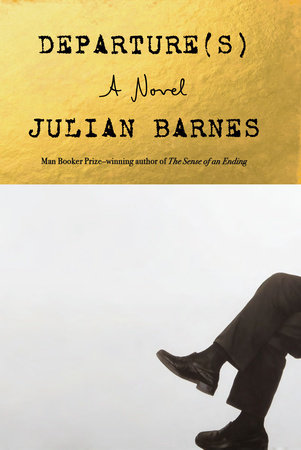
 CBR18 BINGO: Left, because this is Julian Barnes’s last novel; ergo, there’s nothing left
I’ve always had a difficult relationship with Julian Barnes. Sometimes I read a line and think, “What a genius. No wonder he won the Booker Prize.” Then I read a bit more, and I just feel tired.
Departure(s), which Barnes has said is going to be his last book, is a blended novel, comprising elements of memoir, essay, and fiction. This format is what prompted me to realize that, as a general rule, I enjoy Barnes’s musings more than his fiction. Departure(s) opens with the author contemplating Involuntary Autobiographical Memory (IAM), the spontaneous recollection of past events, usually triggered by an everyday or common occurrence. A famous example of IAM occurs in Marcel Proust’s In Search of Lost Time, when the taste of a madeleine dipped in tea transports the narrator back to his childhood (as well as in this iconic scene from Ratatouille). Barnes the author is interested in “ghoulish and extreme” topics, so he was delighted when a friend sent him an article titled, “Proust and madeleine: Together in the thalamus,” which recounts the case of a 45-year old man who suffered a stroke, the result of which is that, every time the man tastes an apple pie, he’s assaulted by a rush of memories of every pie he’s every tasted, in chronological order no less. Barnes reacts to this discovery with alarm: “Imagine such high-speed assaults by forgotten memories, a historic avalanche roaring across your perception of the present, tearing up your very sense of yourself.”
Memory and perception are frequent topics in Barnes’s books, and if this had been a 20-page essay on IAMs, I’d have probably given it 5 stars. I know, some of you are probably already tired and may consider Barnes too pretentious and wish he’d just get on with the story. For whatever reason, I enjoy his reflections, his meditations, his turns-of-phrase; the man can certainly turn a phrase.
The fictionalized part of the story is about two friends of narrator Julian. In college, he introduces “Stephen” and “Jean” (names changed because Julian had promised Jean never to write about them), who become a seemingly happy couple. At the end of their last year in school, they break up, because that’s what people did back then–break up or get married. Many years later, when they are all “pensioners,” Julian brings them together again at Stephen’s prompting. He watches in disappointment as the second relationship turns sour, serving as listener and neutral party to their woes.
Throughout the novel, Barnes references his (fictionalized?) journal to reference autobiographical content as well as details about Stephen and Jean. Again, the bits of insight, the “writing about writing,” are portions I really enjoy. One observation he makes: “Writing. . . makes me calm. The concentration on the words, on getting it as true as I can. This was the same when Pat [my wife] was dying. Terror and anguish were kept away by writing about terror and anguish.”
Overall, though, I felt less than satisfied. I also finally recognized a pattern in Barnes’s fiction that irks me. It seems to me (and I’m working from distant memories here) his female characters are perpetually unsatisfied with the way they are being loved by their partners: either it’s too much, or not enough, or just not right in some way. This might be totally fair to the situation, and it can work, as in A Sense of an Ending. But when it becomes a pattern, when female characters consistently don’t feel loved the correct way, but aren’t able to use their words to convey that message, it troubles me. I don’t think Barnes is being sexist–he clearly admires the women in his novels. I’m just wondering how many women he’s ever really understood. As I said, I’m working from my memory, and goodness (and Barnes) knows that memory is faulty, but the non-love story in this book vexed me. I kept pushing through waiting for more bits about Proust.
So, a middling review for this novel by a talented master of the English language. Perhaps in a few years I’ll remember it differently.
