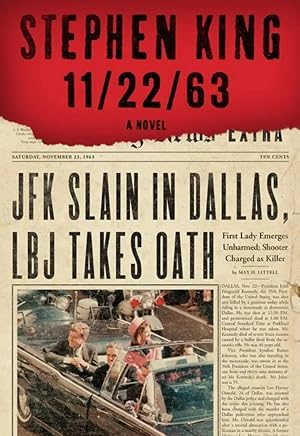
 CBR18 BINGO: Repair, because the main character goes back in time to try to repair the damage caused by JFK’s assassination
I had a high-school English teacher who mused that she didn’t think Stephen King would ever be counted among the “classics” because the sheer volume of his output inevitably led to some substandard attempts. Plus, there was the whole tie in with movie deals that undermined his legitimacy (this was back in the ’80s, when it wasn’t necessarily a given that a popular book would be adapted into film). I couldn’t help remembering that teacher when I was reading 11/22/63 and thinking, “Wow, you were so wrong.”
High school teacher Jake Epping is approached by his friend Al Templeton, the owner of a local diner that Jake frequents. Al is dying of lung cancer, even though Jake had seen him the day before and he had seemed perfectly healthy. To cut to the chase (which King does very quickly), there’s a portal in the back of Al’s pantry that opens up in 1958. Al has spent the last several years in the past, which explains how the lung cancer came upon him seemingly overnight. Al explains that every time he uses the portal, he returns to September 9, 1958, and when he comes back through to the present, a mere 2 minutes will have passed. Any changes he causes in the past will be in effect when he returns to the present, BUT, re-entering to 1958 resets the original timeline.
Al explains to Jake his plan–go back to 1958 and prevent Lee Harvey Oswald from assassinating John F. Kennedy. Al believes that if Kennedy had survived, the Vietnam War would have been prevented, and millions of lives would have been saved. Unfortunately, Al’s lung cancer is paced to kill him before he can make it to 1963. He wants young, heathy, divorced Jake to pick up the mantle and carry out his plan.
The first thing I loved about this book is that King doesn’t expect his readers to be idiots. He anticipates readers’ reservations and addresses them–why didn’t Al just track Oswald down in 1958 and kill him then? What about paradoxes caused by the time travel? King addresses the readers’ doubts, sometimes with a definitive response, other times with a bit of a hand wave from Al, who essentially says, “Look, I don’t know everything about how this portal works; you’re going to have to figure out some of it for yourself.” Before I even had a chance to wonder why mild-mannered Jake Epping would go along with Al’s plan, Jake asserts, “I had a job I was good at, but if I told you it was challenging, it would be a lie. Hitchhiking around Canada with a buddy after my senior year of college was the closest thing to an adventure I’d ever had. . . . Now, all of a sudden, I’d been offered a chance to become a major player not just in American history but in the history of the world. So yes, yes, yes, I wanted to be convinced.”
This novel is part science fiction, part historical romance, and part thriller. Jake quickly becomes seduced by the idyllic life he encounters in the late 1950s (while recognizing that he represents the correct demographic to enjoy all the perks of the time period), and the time he spends teaching high school English in Jodie, Texas, is the most sentimental portion of the novel. He exerts a George Baileyesque influence on the students and teachers there, in one instance helping a shy football player named Mike realize his love and talent for acting. Mike’s performance as Lenny in Of Mice and Men becomes one of the most moving moments in this story. “Right then I wasn’t thinking of John Kennedy, Al Templeton, Frank Dunning, or the world I’d come from. Right then I was thinking of nothing but this big boy. . . and my show. Because at some point it had become mine, just as this earlier time with its party-line telephones and cheap gas had become mine. At that moment I cared more about Of Mice and Men than I did about Lee Harvey Oswald.”
For all the beauty of the scenes in Jodie, King is a master at creating a feeling of disquiet underneath it all. One can’t just go back in time and fall in love with a librarian and murder a potential assassin without there being repercussions, and King never lets the reader feel completely at ease. For every sweet moment, there’s something that feels “off.” For every happy encounter, there’s a sense of the past fighting back, not wanting to change–“The past is obdurate,” is a frequently-quoted theme.
At 850 pages, this novel moves. The realism is such that, at one point, I found myself reading furiously in anticipation of finding out for sure whether Lee Harvey Oswald acted alone, until I remembered that I was, in fact, reading fiction. The characters feel substantial to the point that I became as invested in them as Jake was. I almost wish the ending had been drawn out a bit longer, so that I could have found out what happened to more of the key characters.
I loved, loved this novel–highly recommend. Bonus thought: King is known to be a voracious reader, and you can see that influence in his writing. I got two short story recommendations out of 11/22/63, which I’ve already read: “The Summer People,” by Shirley Jackson, and “The Open Window,” by Saki (H.H. Munro). Enjoy these bonus reads!
