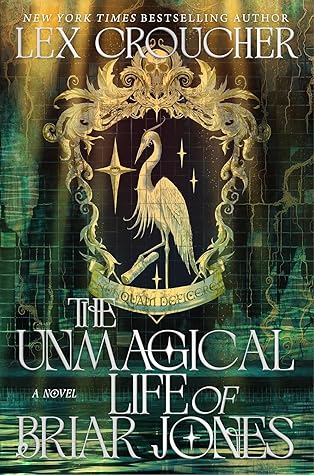
 ooh this is also cannonball for me!
I’m in a really generous mood these days, aren’t I? But here I have a real view as to why I think this is a four with an asterisk: 1) I wonder if some of my ennui was wanting all of these terrible characters to be truly redeemed, in a juvenile sort of “pull the covers back and it was all a misunderstanding” way and 2) these are 18-year-olds and our main romantic leads last saw one another when they were ten (10) which makes the romance at the center of it all a bit eh, but I think it’s better than that would appear.
Confusing summary done, let me explain in some more detail. Fair note that there are some heavy content warnings and lots of really, really awful behavior in this book, both on page and referenced.
Briar and Seb grew up in a small village somewhere in Ye Olde England, mere miles away from Temple School of Thaumaturgy. Is it a magic school? I mean, yes if you think so and are like wtf is Thaumaturgy, but also no one has ever confirmed it and it’s not like magic is real, right. The book takes place in our world, which means it’s not like we wander around knowing that the rich and powerful are using magic to get their riches and powers, but also if someone told you that the reason a hack like Elon was able to become a trillionaire was magic you’d be like, yeah tracks. In any case, both of them are a bit Other–Briar a non-binary and highly loved kid of a financially strapped sheep farmer, and Seb the lonely son of a fancy manor house. Their friendship is strong and rich in the way that friendships are when you are that young, and they both have grand dreams of going to Temple together and one day changing the world. They think it’ll be like Ursula Le Guin or Tolkien, or at a minimum much better than their current shit.
Except when they apply, Seb gets in and Briar does not. And then Seb and Briar don’t talk until Briar, 18, takes a temporary staff job at Temple (clearing out a junk room) that’s not <i>not</i> because they never got over not getting in. When he arrives, he realizes that 1) magic is actually, 100% real and 2) Temple is actually a sociopathic combination of every “bad English boarding school” trope you can imagine–it’s misogynistic, racist, transphobic, homophobic, classist, and probably some more isms that I can’t recall. New entrants (pips) are put through a series of increasingly sadistic hazing rituals to guarantee their absolute loyalty and secrecy to the powers that are taught, which of course are used by the (mostly male, mostly white) alumni to ensure endless amounts of success in all the usual spheres (politics, law, finance). Everyone who enters ends up beaten down and turns evil, looking out only for themselves and able to justify the worst excesses.
Except, sort of, three seventh years whom Briar runs into on their first day, who become their official/unofficial school buddies: gay, Black, female, so a trifecta of people who have personal reasons to hate the school, and are attempting to sabotage the year’s prefects (in particular its head prefect, Alistair, a budding little fascist) by ruining the hazing Trials and therefore losing them their school board-sanctioned entries into the ruling class. Briar is reluctantly and then full throated-ly on board, after seeing how their sensitive, kind friend has turned into mini sociopath, who is so powerful that any offhanded command is immediately turned into a compulsion by anyone around.
That’s a lot of plot, but what I want to get across the sheer feeling of despondence that takes over most of the book. In this world, magic basically grows as you study it more, and the more you study the more you can impress your will on others. There is no “and then they found a trick to overcome,” it’s more like strict power levels. Once you reach level 10, then anyone 9 or below is unable to best you in a match of magical wills, which means you’re susceptible to being told to kneel, or tell the truth, or hurl yourself head-first thirty feet into an empty concrete pool (all things that happen in this book! keep yourself safe, kiddos!). There’s a bit of a disconnect between why Briar, ostensibly an outsider, would go through the immense risk of helping these new friends of theirs to mildly inconvenience one (1) class of students from a school that’s produced generations of sadists, but Croucher does a decent job of making us believe in Briar’s mullish sense of ethics and right versus wrong.
It’s also a decently tight book for how much world building there is: there remains one main plot, and the ancillary activities and subplots do eventually meet up with the main issue (that Temple is producing sociopaths that take over the world). I enjoyed this new form of magic, which is based on putting in effort and learning spells–the more effort, the better you get, and there’s no real shortcut. The fact that in hundreds of years only three (3) students seem to care that the school is producing morally vacant monsters is less unbelievable that you think.
My biggest issue is that all of the characters are sort of terrible and do some pretty terrible things, and they just…are forgiven, with varying degrees of believability for each. One character almost kills another in pursuit of justice, and then gets cold feet almost immediately after. When asked to justify why, the character admits that they have a much more personal relationship with the head prefect and wanted to see him taken down no matter the cost to this character’s friend. It’s sort of hard to stomach, but does go by pretty quickly and is logically consistent within the story.
The second issue could have been solved quite easily, in my opinion–have Seb and Briar be older when Seb goes off to Temple? Even aging them up a few years, such that their fracture occurs post puberty, gives more heft to the notion that this friendship and its dissolution wrecked both of these boys. I’m someone with quite strong friendships, and I absolutely buy that a friendship breakup can be as traumatic or more than a romantic one (and so a romantic x friendship duo is doubly heartbreaking) but at ten years old it’s a bit harder to countenance.
