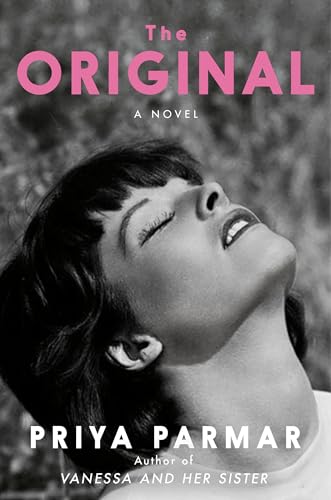
Fiction about real people is a double-edged sword. On the one hand, the author is free to use their imagination to take the reader behind the scenes or into the private moments of public figures, creating a picture of them unavailable to historians bound to stick to the record. If done judiciously it can be humanizing. But if done haphazardly, these inventions can needlessly cause confusion if readers take the book as fact.
The Original is a novel about Katharine Hepburn’s early Hollywood career, beginning with her initial successes, carrying on through her “box office poison” phase, and culminating with the triumph of The Philadelphia Story. Cary Grant, Howard Hughes, David and Irene Selznick, Randolph Scott, and several other real-life figures from early Hollywood play prominent roles in the story, but the focus remains on “Kate.”
As in real life, Parmar’s Kate grows up with a wealthy, patrician family in Connecticut, her father a prominent surgeon and her mother an advocate for women’s causes, including birth control. But behind that patina of privilege lies a tragic backstory, as both sides of Hepburn’s family have a history of suicide. Kate’s beloved brother Tom takes his life when Kate is a teenager, a loss that she feels for the rest of her life.
Kate moves to Hollywood over her father’s objections, quickly finding work due to her striking, unusual good looks, impressing directors and producers with both her talent and her fierce independence. Her career, however, is threatened by persistent rumors about her sexuality. (In Parmar’s telling, Kate is explicitly conducting an affair with her friend Laura Harding, while in real life her orientation is still debated. In a parallel narrative, Kate’s friend and future co-star is similarly caught between his ambition and his love for fellow actor Randolph Scott.
Unfortunately, just as Kate’s career stalled after her early successes, The Original gets bogged down in its vast midsection. Parmar takes forever to get through some rather uninteresting material. It’s also in this part of the story where Parmar makes the boldest injection of fiction into Hepburn’s real-life story. To explain a gap in Hepburn’s career, and with a minimal amount of evidence of some kind of health issue, Parmar invents a medical emergency for Kate which results in lasting consequences.
As someone who has previously read a biography of Katharine Hepburn, I was at first shocked that this condition hadn’t come up, or that I’d forgotten it if it had. Finding out that it was actually Parmar’s invention was even more surprising. It changes so much of Hepburn’s actual story, in a way that I think takes away from her legacy. It’s a shocking inclusion that commits the further sin of not adding particularly much to the narrative.
Katharine Hepburn is one of Hollywood’s greatest legends, and it’s fun to get inside her head for a little while. I just wish Parmar could’ve stuck a little closer to the facts and still delivered a compelling read.
