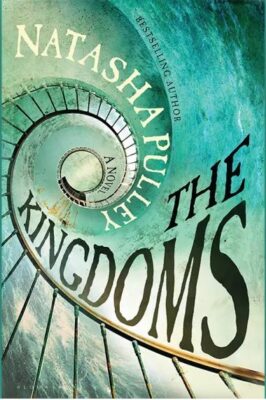
 I didn’t put the pieces together, but Natasha Pulley’s debut was The Watchmaker of Filigree Street of similar handwavy magic meant to help the stoic repressed gays together in all locations and time eras–and in this case, multiple!
RIGHT SO plot, quickly: Joe is our main character, who has woken up on a train pulling into what he thought was Kings Cross station but is now Gare du Roi station. It is 1897 ish, everyone is speaking French, and while he has literally no memory of anything he can also speak French–because, of course, the UK is a French colony, having lost at Trafalgar and been conquered by the French. As happened in history.
A kindly stranger takes him to the local hospital, where a French doctor gives him a week to recover his memories out of mild interest. Luckily, a French gentleman who lives in London comes to grab him–Joe is one of his enslaved Brits, tried to run away and/or got lost, how tragic! Joe returns to his former life, convinced he had a bad epileptic fit, except that the next day a postcard with a picture of a lighthouse arrives, postmarked incredibly from almost a hundred years prior, with a simple message (Dearest Joe, if you remember me, come) and signed only “M.”
The lighthouse propels Joe to get a job as a lighthouse engineer, and then volunteer for a onsite repair job at the lighthouse on the postcard, even if it means leaving behind his young daughter Lily. Up there, he discovers that two pillars sunk into the ocean bedrock en route to the lighthouse are actually framing a portal back in time, to before the loss to the French, and that there’s a single-minded and terrifying captain named Kite who is waiting to grab him and try to glean any bits of future events or history required to re-rechange history to what we know of as “our” history, where Nelson defeated the French–because that’s what the French did, stumble upon a group of future Brits and torture out of them enough information to change history in the first place.
Joe could potentially change all of that, but doing so would also change Lily out of history. So, like his very own horrific trolley problem, he’s left to consider the cost of thousands of navy lives and the future of the UK against the very existence of his beloved daughter–all the while trying to avoid upsetting Kite, who thunders around and threatens anyone who even dares to speak to Joe about who he might have been before the memory loss and how he plays into this whole saga.
Much like Kite, I don’t want to give away any more of the plot except to say that it really gets in there and wrenches with your heart, even though there are a few excellent bits that in my mind would completely sell the work–I had queued this up over a month ago and for some reason never wanted to start, not fully having realized what the vibe was. The vibe is epic, sweeping, bittersweet romance across a hundred years and war and bloodshed. It’s a slow burn love story, but mostly love as driving force as opposed to conclusion–Joe’s love for Lily, the growing attraction between him and Kite, the complicated love between Kite and his older half-sister Agatha.
I especially like that Pulley doesn’t belabor the whys and wherefores of the time travel portal. It just…is, and aside from a memorable and very character illuminating bit with tortoises, its existence is just a convenient MacGuffin to move the main plot forward. I’d honestly forgotten some of the rules of time travel in this universe by the time I needed to recall them, but Pulley does a good job of reminding you of what’s happening without overexplaining.
In general, that sense of patience–letting you be confused and learn what’s going on more or less in time with the main characters–is becoming more of a rarity in our attention challenged world, I feel. If you, like me, are bemoaning the lack of ‘show don’t tell’ narratives, this will be a breath of fresh air.
