 “Ronnie Childers was tripping his balls off in Jackson Square when an angel of the Lord appeared before him. She was a glorious vision, dressed in black gym leggings and a Bikini Kill T-shirt, her golden hair twisted into a messy knot on the top of her head.”
First of all, best opening lines I’ve read in ages. I flipped open to page one to get a flavor of what this book was like and didn’t want to put it down. That’s a strong beginning, for sure.
Now down to business. I love Little Free Libraries, I hate book banning, and I agree with everything this book has to say. I enjoyed it well enough, but I didn’t love it, and we’ll get to why in a minute.
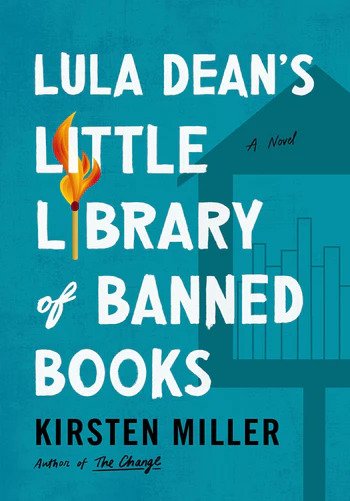
In Troy, Georgia, Lula Dean has taken to campaigning against books that might warp the town’s children. Really racy stuff, like Lord of the Flies and Anne Frank’s Diary of a Young Girl. Now, a cynical person–or say, anyone with any observational skills–might say that Lula is a nobody who has finally found a way to feel important and that banning books is more about power for her than any concern for the local children. To demonstrate that she doesn’t oppose reading, Lula puts a Little Library in her front yard and fills it with wholesome books like The Southern Belle’s Guide to Etiquette and The Art of the Deal. Enter Lindsay Underwood, the aforementioned angel of the Lord and daughter of Lula’s arch nemesis, Beverly Underwood. Lindsay and her friend Ronnie switch out the wholesome books in the library with banned books, hiding them behind “wholesome” dust jackets. People pick up books out of Lula’s Library and start reading. Minds are opened; rifts are healed; true selves are known. At least in some cases–there are still some closed minded people in Troy who don’t like the direction things are headed.
The story is amusing (though it didn’t reach the over-the-top level of comedy I was hoping for when I read the first two lines) and it’s got a wonderful, diverse cast of characters. It addresses not just book banning, but civil rights, sexual assault, male fragility, and problematic Southern culture. Three cheers for all that! The problem is it’s very much preaching to the choir, although that didn’t particularly bother me for at least the first half. True, the book banners and the folks fighting to save the Confederate war statue in the town square are 1-dimensional, stupid, and sometimes outright evil. I normally get more annoyed when a book lacks subtlety, but I felt like it was warranted in this case, as nothing that came out of those characters’ mouths was anything I hadn’t personally read on social media. And this book isn’t intended to change anybody’s mind–it’s for those of us who are scared about the direction the world is going right now and want a happy ending.
I just wish that this book didn’t get so. . .precious at times. There’s a particularly cringey scene toward the end where a mom learns in front of a crowd that it’s alright that her young son read Are You There God? It’s Me, Margaret, because before reading it he thought the stuff under her sink meant she was sick and going to die. Hoo boy. And it turns out that Lula Dean has two very liberal children, one of whom is a drag queen, and they strong arm her into being nicer in the end.
There are some genuinely touching moments. I particularly enjoyed that the brother of a young man who recently came out as gay read a same-sex romance hoping to understand a) if the book made his brother gay and b) what his brother is feeling. In the end, he found the novel dreadfully boring and was certain that nothing in it could cause a person to become a homosexual. Eventually, the young man’s parents also read the novel, which is pretty sweet.
I enjoyed this book well enough, and I know that many people will love it. You aren’t going to be faced with anything nuanced, but if you want to read something that addresses many issues of the day while also giving you a happy ending, you will be thrilled.
