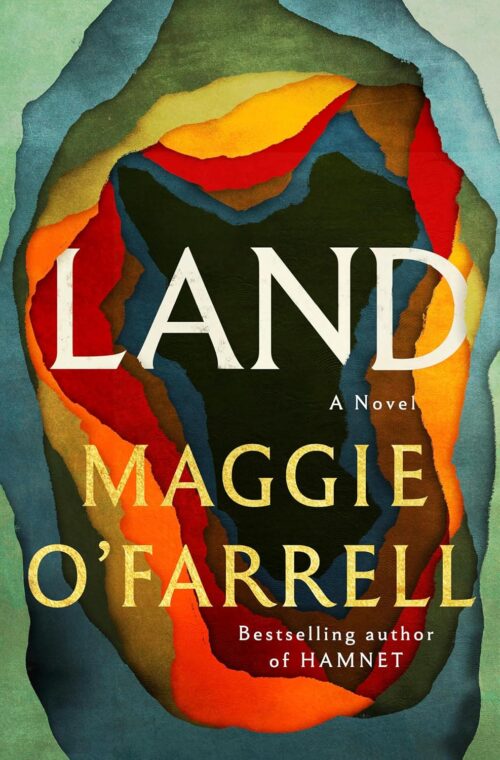
The beginning of Maggie O’Farrell’s Land finds ten-year-old Liam out in the woods in an unnamed, remote Irish peninsula with his father, Tomás. It is not long after the Great Famine decimated the population. At the behest of the British army, they are surveying the area to make accurate maps, interviewing the remaining locals to ascertain the names of hills, lakes, and other geographic formations, all of which Tomás has to render into English from their original Irish. When Liam gets lost in the woods and panics, Tomás has to go in search of him, only to get much more lost himself. Liam makes it back to the widow’s cottage where they had been staying relatively unscathed, but it’s days before Tomás emerges from the woods in a daze. Tomás has had an epiphany of sorts at a local wellspring rumored to have magical properties. He no longer wishes to map the land for the redcoats, but instead wants to make a map using the Irish language so that the people who live on the land can see their home preserved forever.
Tomás moves his family onto the peninsula, where he farms and pursues his project while trying to make ends meet without returning to work for the British. O’Farrell then expands the story to reach back into Tomás’s past to show the reader his struggle through the famine, his time in a workhouse for orphans, his meeting with his fellow orphan and future wife Seraphina, and the random chance that leads to his surveying career. At the same time, we learn more about the personalities of his children. There’s meek and mild Liam, intimidated by his father’s manliness and drawn toward a life in the church. His sister Enda is strong-willed and bright, seemingly headed toward becoming a teacher until her father’s rash decision to uproot the family leaves her with no access to schooling. The family expands to include two more children, the sweet-natured Rose who tries to keep everyone together, and baby Eugene, a mute who seems more suited to the land than any of them.
O’Farrell also takes the reader on an extended journey into the distant past, pausing the main narrative to show us a miniature history of Ireland from prehistoric times to the present-day of the novel’s setting. It’s a captivating section that pays major dividends later on in the book.
As time marches on and change comes to both Ireland and the family, they all adjust and adapt in different ways. O’Farrell follows them as they leave home, stay behind, or perhaps leave and return. She has a knack for showing how even people who love each other very deeply can hurt each other by being selfish or short-sighted.
For the first half to two-thirds of Land, I was reading in complete awe of O’Farrell’s command of her characters and story. She has the rare gift to just start writing about a boy standing in a field and make you feel that boy standing there in that field. Liam, and Tomás, and Enda, and Seraphina and the others became quite real to me while I was reading. It was terrifically exciting. I found myself reading snatches of the book whenever I had a spare moment, eager to find out what was going to happen next.
Sadly, though, I have to say that at some point it began to feel to me like O’Farrell started spinning her wheels, unsure of where to go next or of what she wanted to say. As the characters split apart from each other and began their own narratives, it increasingly felt like O’Farrell was relying more and more on cliched immigrant stories and stock characters instead of the lively, new ones she had created. The story meanders fruitlessly, switching back and forth to create the illusion of momentum when in reality it has completely stalled out.
I limped to the finish of Land, practically heartbroken at the wasted potential. O’Farrell writes so beautifully, but in the end it felt purposeless. It’s hard to discern any meaning or message in the back half of Land, other than perhaps a generic “life sure is full of surprises, most of them sad.” Is that really all there is to it? Perhaps others will disagree, but that’s all I could find and that doesn’t feel like enough.
